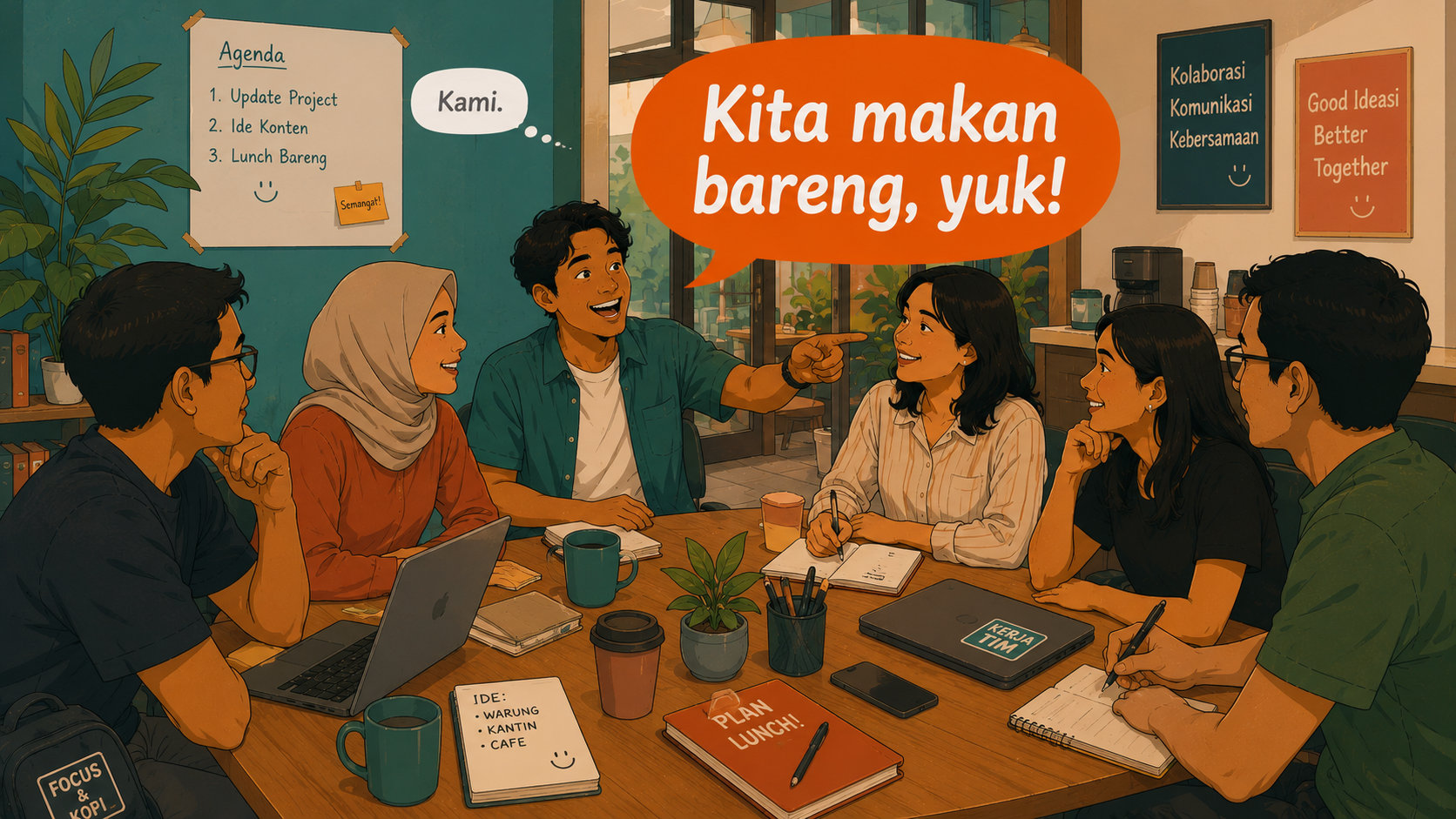
Kami vs Kita: What Your Textbook Gets Wrong About 'We' in Indonesian
Your Indonesian textbook probably has a whole chapter on this. Two words for "we." One that includes the listener. One that doesn't. Diagrams. Exercises. Maybe even a quiz.
And look.. the distinction is real. It exists. But here's the thing.
In casual Indonesian? People mostly just say kita.
For everything.
The Textbook Version
Let's get the "correct" version out of the way first.
Kita = we, including the person you're talking to. Inclusive.
Kami = we, excluding the person you're talking to. Exclusive.
So in theory:
- Kita mau makan (We're going to eat — you're invited)
- Kami mau makan (We're going to eat — not you though)
English doesn't have this split. "We" is just "we." You figure out from context whether you're included or not. Indonesian built the distinction right into the grammar.
Pretty elegant, honestly.
What Actually Happens on the Street
I spent my first few weeks in Indonesia carefully picking between kami and kita. Choosing the right one. Feeling proud of myself.
Nobody noticed. Nobody cared. Because almost everyone around me was just using kita for both.
Kita mau ke mana? (Where are we going?)
That's the phrase you'll hear fifty times a day. At the warung. In the Grab car. Walking around with friends. It doesn't matter if the listener is coming along or not. Kita is the default.
Kita kemarin pergi ke mall (We went to the mall yesterday). The listener wasn't there. Textbook says this should be kami. But nah. Kita sounds warmer. More natural. Less like you're drawing a line between "us" and "you."
And that's kind of the point.
Why Kita Wins
Indonesian culture leans communal. Gotong royong. Shared effort. Togetherness. Using kita pulls people in. It says "you're part of this." Even when technically.. you weren't there.
Kami creates distance. It says "our group, not yours." That's useful sometimes. But in casual conversation? It can feel cold. Formal. A little stiff.
So kita just.. took over.
It's not laziness. It's warmth. Indonesians default to inclusion. The pronoun reflects that.
Kita-Kita: The Inner Circle
Now here's a fun one. Kita-kita.
Reduplication in Indonesian usually means plurality or emphasis. Kita-kita means something like "us folks" or "our group." It's cozy. Intimate.
Nanti malam kita-kita mau nongkrong di sana (Tonight our crew is gonna hang out there).
Kita-kita aja yang tahu (Only us folks know about it).
It's got this conspiratorial energy. Like you're in on something together. You'll hear it a lot among friend groups making plans. It signals belonging.
There's no equivalent of kami-kami. That's not a thing. Which tells you something about which pronoun people actually feel comfortable with.
When Kami Actually Shows Up
Okay so kami isn't dead. You will hear it. But notice where.
Presentations. "Kami dari perusahaan X ingin mempresentasikan.." (We from company X would like to present..)
Official letters. "Dengan ini kami memberitahukan.." (We hereby inform..)
Speeches. "Kami mengucapkan terima kasih.." (We express our gratitude..)
News broadcasts. "Kami laporkan dari lokasi.." (We report from the scene..)
See the pattern? Formal. Professional. Written. Structured.
Kami lives in the boardroom. Kita lives in the street.
When a politician says kita, they're trying to sound like one of the people. When they switch to kami, they're speaking as an institution. Indonesian speakers pick up on this instinctively. The pronoun choice signals register.
The Exception That Proves the Rule
There is one casual context where kami still pops up naturally. When you're explicitly contrasting your group with someone else's.
Kalian mau ke Bali? Kami mau ke Jogja. (You guys are going to Bali? We're going to Jogja.)
Here the contrast matters. You need to draw the line. Kita would be confusing because.. wait, are we all going to Jogja together?
But even here, plenty of people would just say kita and let context sort it out. The "rule" is more of a suggestion at this point.
What This Means for Learners
If you're learning Indonesian, here's my honest advice.
Use kita. For almost everything. In conversation, texts, casual emails. It'll sound natural. Nobody will correct you. Nobody will even think about it.
Learn that kami exists. Recognize it when you hear it. Use it if you're writing something formal or giving a presentation in Indonesian.
But don't stress about picking the "right" one in daily speech. The textbook distinction is fading in casual usage. It's been fading for a while. You'll sound more natural using kita everywhere than carefully switching between the two. 🎯
The Bigger Lesson
This is one of those things that makes language learning tricky. Textbooks teach you the grammar. They don't always teach you the culture. The grammar says kami and kita are different. The culture says "just use kita, it's friendlier."
English doesn't force this choice at all. "We" is "we." But Indonesian gives you a window into how the culture thinks about groups and belonging. Even when the formal distinction blurs, the preference for kita tells you something. Inclusion is the default. Community is the baseline. You're part of the group until stated otherwise.
That's a pretty good philosophy, honestly. 🤝
Quick Cheat Sheet
| Situation | Use | Example |
|---|---|---|
| Chatting with friends | kita | Kita jalan yuk (Let's go) |
| Texting plans | kita | Kita ketemuan jam 7 (Let's meet at 7) |
| Talking about your group | kita | Kita semua udah di sini (We're all here) |
| Inner circle vibes | kita-kita | Kita-kita aja (Just us folks) |
| Formal presentation | kami | Kami ingin menyampaikan (We would like to convey) |
| Official letter | kami | Kami mohon maaf (We apologize) |
| Clear contrast needed | kami | Kami yang bayar (We're the ones paying) |
One Last Thing
I used to overthink this. Pausing mid-sentence to pick the right pronoun. Meanwhile the person I was talking to had already moved on to the next topic.
Language is about connection. Kita connects. Use it. Move on. Talk about something more interesting. 😄
So here's my question for you. If you've spent time in Indonesia, when was the last time you actually heard someone use kami in casual conversation? I'm betting you have to think pretty hard about that one.
Keep learning
Related articles
How to Say 'Menggunakan' in Casual Indonesian (Just Say 'Pake')
Drop the meng- prefix and sound way more natural. Menggunakan becomes pake in everyday Indonesian conversation.
How to Say 'Anda' in Casual Indonesian (Kamu, Lo, Lu)
Anda is formal. Stiff. Weird with friends. Here's what to actually say instead: kamu, lo, lu, or just skip 'you' entirely.
How to Say 'Uang' in Casual Indonesian (Duit)
Uang is the textbook word for money in Indonesian.. but duit is what people actually say. Plus the slang terms for common rupiah amounts.