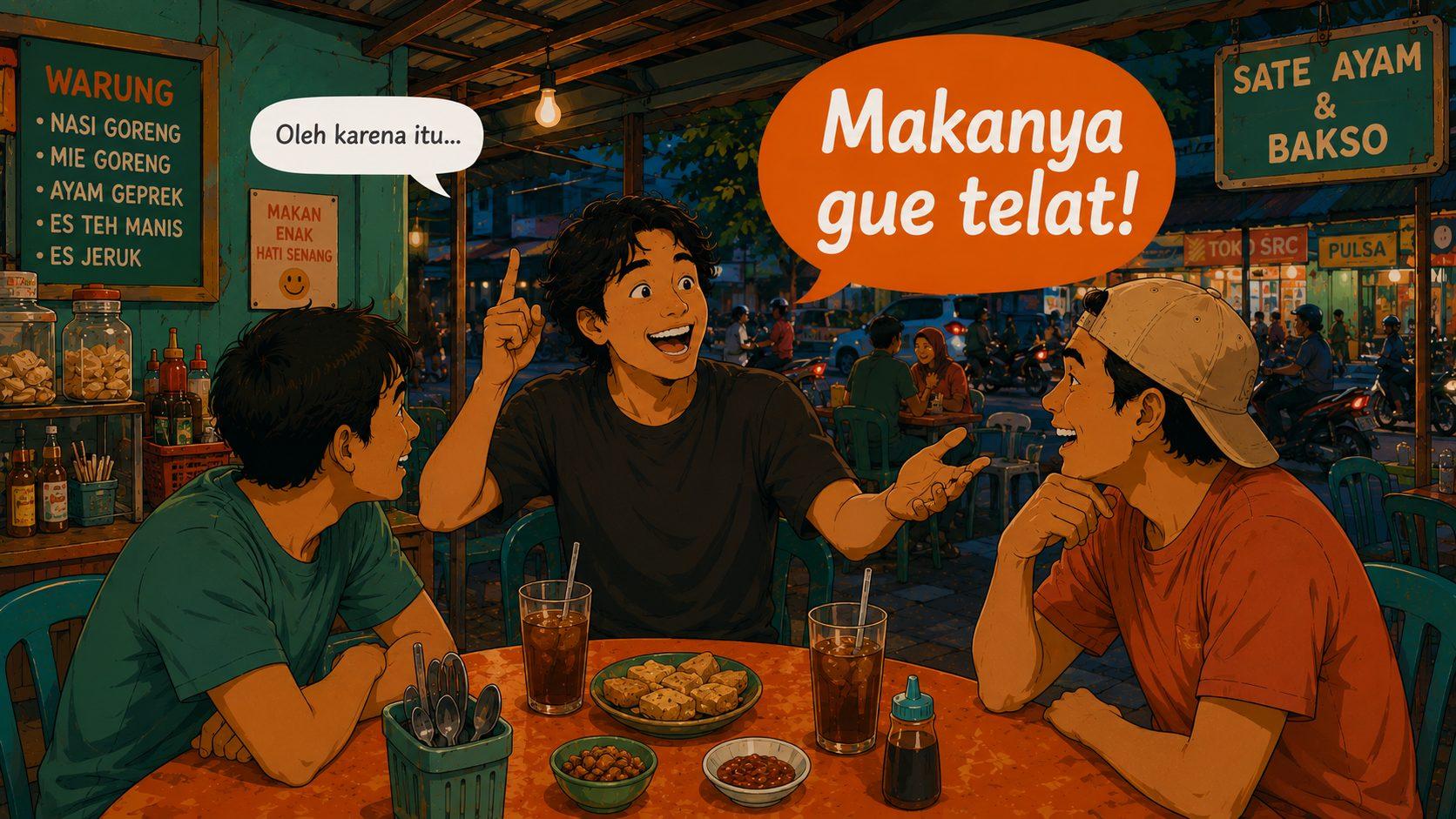
How to Say 'Oleh Karena Itu' in Casual Indonesian (Hint: Nobody Says That)
You know what kills a vibe faster than anything? Dropping "oleh karena itu" in the middle of a casual conversation.
I did this. In Jogja. At a warung. Telling a story about missing my bus. The guy next to me literally paused mid-bite and looked at me like I was reading a news broadcast.
He wasn't wrong.
The Textbook Trap
Indonesian language courses love formal connectors. They teach you words like:
- Oleh karena itu (therefore)
- Selanjutnya (next/furthermore)
- Kemudian (then/subsequently)
- Sebab (because)
- Agar (in order to)
These words are real. They exist. You'll find them in newspapers, academic papers, presidential speeches. They're not wrong.
But nobody talks like that.
Imagine your friend telling you about their weekend in English: "I went to the store. Subsequently, I drove to the beach. Therefore, I got sunburned."
Weird, right? That's exactly how you sound using formal connectors in casual Indonesian.
The Real Words People Use
Here's your cheat sheet. Burn it into your brain.
"Oleh karena itu" → makanya / jadinya
This is the big one. "Oleh karena itu" means "therefore" and it's five syllables of pure formality. Real people say makanya or jadinya.
Textbook version: Saya tidak bawa payung. Oleh karena itu, saya kehujanan. (I didn't bring an umbrella. Therefore, I got rained on.)
How people actually talk: Gue nggak bawa payung. Ya makanya kehujanan. (I didn't bring my umbrella. That's why I got rained on.)
Or even shorter: Jadinya kehujanan deh. (So I got rained on.)
Makanya has this beautiful "I told you so" energy too. Your friend eats street food from a sketchy cart and gets sick? Makanya jangan jajan sembarangan. (That's why you shouldn't eat just anywhere.) It's half-connector, half-lecture. Indonesians love it.
"Selanjutnya" / "Kemudian" → terus / abis itu
These are your story-chaining words. And they matter so much because storytelling in Indonesian is basically a sport.
Textbook version: Saya pergi ke pasar. Kemudian saya membeli sayur. Selanjutnya saya pulang ke rumah. (I went to the market. Then I bought vegetables. Next I went home.)
That sounds like a police report.
How people actually talk: Gue ke pasar, terus beli sayur, terus pulang. (I went to the market, then bought veggies, then went home.)
Or: Ke pasar dulu, abis itu beli sayur, abis itu pulang.
See the pattern? Terus.. terus.. terus.. That's how real stories flow. Sometimes people chain four or five "terus" in a row. It sounds repetitive on paper. In conversation it sounds completely natural.
I sat at a coffee shop in Bandung once just listening to the table next to me. I counted. One guy used "terus" eleven times in a single story. Eleven. Zero "kemudian." Zero "selanjutnya." 🔥
Abis itu (or habis itu if you're being slightly less casual) fills the same role. It literally means "after that." People mix and match: Terus.. abis itu.. terus.. abis itu.. It's the rhythm of Indonesian storytelling.
"Sebab" → soalnya / karena
"Sebab" means "because" and it's not the worst offender on this list. But it still sounds stiff in casual speech. You want soalnya or just plain karena.
Textbook version: Saya tidak bisa datang sebab saya sakit. (I cannot come because I am sick.)
How people actually talk: Gue nggak bisa dateng, soalnya lagi sakit. (I can't come, cause I'm sick.)
Soalnya literally comes from "soal" (matter/issue). So it's like saying "the thing is.." It's perfect for giving reasons. Nggak jadi pergi. Soalnya hujan. (Didn't end up going. Cause it was raining.)
You can also just use karena which is the everyday version of "sebab." Nothing fancy. Just normal. Nggak dateng karena males. (Didn't come because I was lazy.) Honest and casual. 😄
"Agar" → biar / supaya
"Agar" means "in order to" or "so that." It's textbook to the core. Swap it for biar or supaya.
Textbook version: Saya belajar dengan giat agar mendapat nilai bagus. (I study diligently in order to get good grades.)
How people actually talk: Gue belajar biar dapet nilai bagus. (I study so I get good grades.)
Biar is the most casual. Supaya sits in the middle. Not as stiff as "agar" but a little more proper than "biar." Both work great in conversation.
Cepetan biar nggak ketinggalan. (Hurry up so we don't miss it.) Makan dulu supaya nggak laper. (Eat first so you're not hungry.)
The Full Story Test
Let me tell the same story two ways. You tell me which one sounds like a real person.
Version A (textbook): Kemarin saya pergi ke mall. Kemudian saya bertemu teman saya. Oleh karena itu kami memutuskan untuk makan bersama. Kami memilih restoran Jepang sebab teman saya menyukai sushi. Kami makan banyak agar kenyang.
Version B (real): Kemarin gue ke mall, terus ketemu temen. Ya udah jadinya makan bareng. Pilih restoran Jepang soalnya dia suka sushi. Makan banyak biar kenyang.
Version A sounds like a language exam answer. Version B sounds like a human being.
Same information. Same story. Completely different energy.
Quick Reference
| Formal (textbook) | Casual (real life) | Meaning |
|---|---|---|
| Oleh karena itu | Makanya, jadinya | Therefore, so |
| Selanjutnya | Terus, abis itu | Next, then |
| Kemudian | Terus, abis itu | Then, after that |
| Sebab | Soalnya, karena | Because |
| Agar | Biar, supaya | In order to, so that |
The Trick to Sounding Natural
It's not just about swapping individual words. It's about flow.
Real casual Indonesian is shorter. Subjects get dropped. Sentences blend together. Connectors become rhythm markers, not grammar tools.
Listen to how people tell stories at a warung. At a hangout. In a grab car. You'll hear terus and makanya everywhere. You'll hear soalnya and biar constantly.
You will almost never hear "oleh karena itu." 😅
When I stopped using formal connectors, something shifted. People started responding to me differently. More relaxed. More open. Like I'd crossed some invisible line from "foreigner who studied Indonesian" to "foreigner who actually speaks Indonesian."
That line? It's made of words like makanya and terus and soalnya. Small words. Big difference.
Start Today
Pick one conversation today. Just one. Replace every formal connector with its casual version. Chain your sentences with terus. Give your reasons with soalnya. Drop a makanya when it fits.
It'll feel weird at first. Do it anyway.
What formal Indonesian word did YOU use for way too long before learning the casual version? Drop it in the comments. I bet we've all been there.
Keep learning
Related articles
How to Say Mengajar in Casual Indonesian (Hint: It's Ngajar)
Learn how Indonesians actually say 'teach' in everyday conversation. Mengajar becomes ngajar, plus all the casual education vocab you need — from les privat to bimbel culture.
How to Say Memotong in Casual Indonesian: Just Say Motong
Nobody says memotong in real life. Learn how Indonesians actually say 'to cut' using motong, potong, and all the slang variations you'll hear daily on the streets.

How to Say Berjalan in Casual Indonesian (Hint: Just Say Jalan)
Berjalan is the textbook word for 'walk' in Indonesian. Nobody says it. Learn how Indonesians actually use 'jalan' — from jalan-jalan to jalan kaki to 'jalan yuk!' — and why this one word unlocks a huge chunk of daily conversation.