How to Say Memotong in Casual Indonesian: Just Say Motong
You learned "memotong" in your textbook. Cool. Now forget it.
Nobody talks like that. Not at the barbershop. Not at the warung. Not anywhere that actual humans hang out and have conversations.
The word you want is motong.
The Shortcut Your Textbook Never Taught You
Indonesian has this pattern. Formal verbs with the "me-" prefix get chopped down in casual speech. Memotong becomes motong. Memakan becomes makan. Memukul becomes mukul. It's predictable. It's everywhere. And once you start hearing it, you can't stop.
"Motong" comes from the root word potong (cut). The formal version is memotong. But say "memotong" to your Indonesian friend and they'll look at you like you're reading a news broadcast.
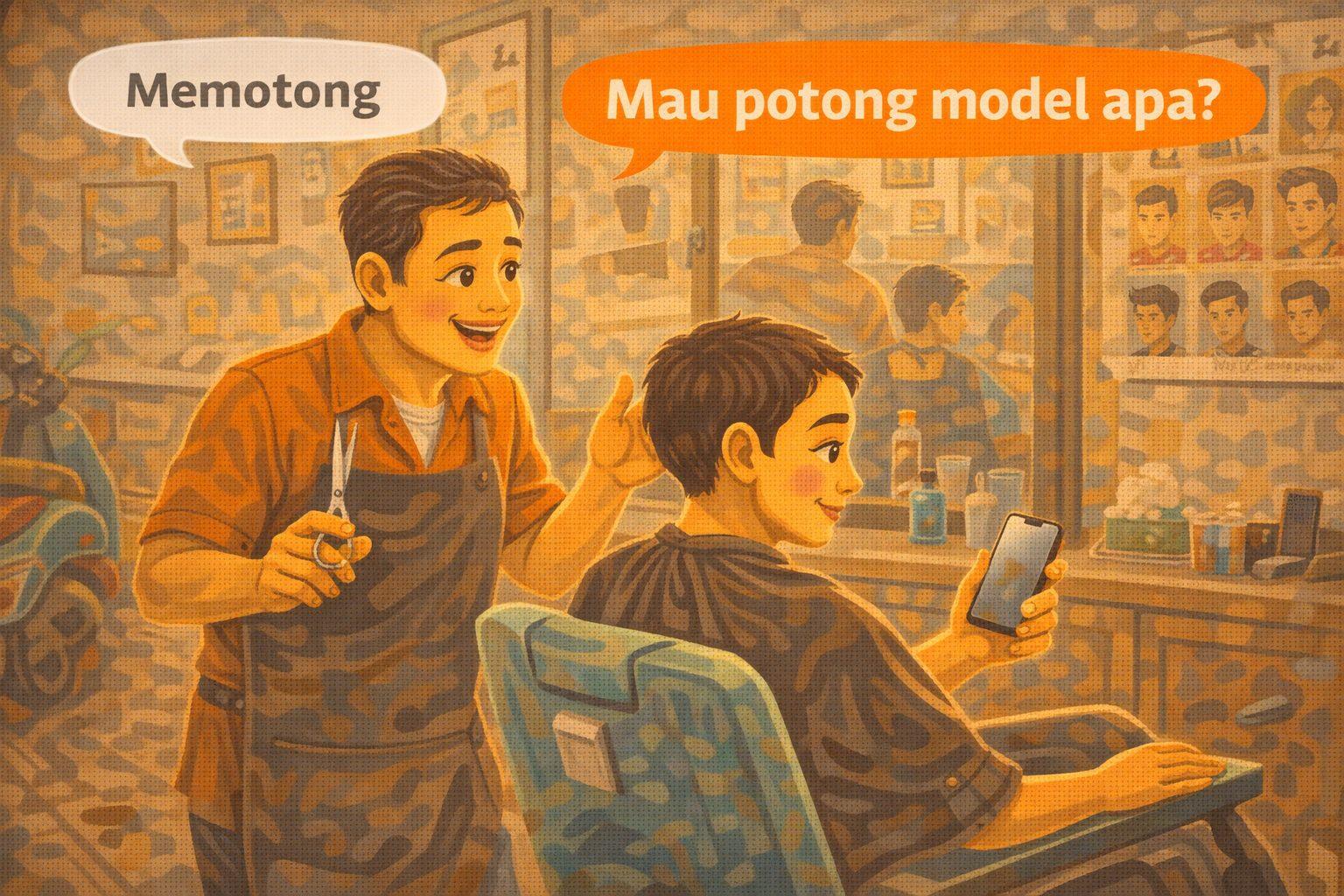
I learned this the hard way. Walked into a barbershop in Yogya, tried to explain what I wanted using my best textbook Indonesian. The barber just smiled and nodded. The guy waiting next to me leaned over and said, "Bilang aja mau motong rambut, bang." (Just say you want to cut your hair, bro.)
That was it. That was the lesson. Three words. Motong rambut. Done.
Motong Rambut: Your First Real Test
Let's start with the most common one. Getting a haircut.
"Mau motong rambut" (I want to cut my hair) is something you'll say constantly if you live in Indonesia. And honestly, you should. Because getting a haircut in Indonesia is an experience.
The tukang cukur (barber) is a cornerstone of Indonesian neighborhood life. Every kampung has one. Sometimes it's a proper shop with mirrors and chairs. Sometimes it's a dude with clippers under a tree. Both are valid. Both will give you a solid cut.
And the price? 💈 I've paid as little as 15,000 rupiah. That's about one US dollar. For a full haircut. With a head massage thrown in. Try getting that in New York.
The conversation usually goes like this:
"Mau motong model apa?" (What style do you want to cut?) "Potong pendek aja." (Just cut it short.) "Pinggirnya mau dipotong juga?" (Want the sides cut too?)
See how potong and motong just flow in and out? That's natural speech. The barber isn't thinking about grammar rules. He's thinking about your hair.
Some barbers will ask "Cukur apa potong?" which is basically asking if you want a shave or a cut. Cukur leans more toward shaving or buzzing. Potong is scissors-and-comb territory. Good to know before you end up bald by accident.
Potong: The Root That Does Everything
Here's where it gets fun. Potong isn't just about cutting physical things. Indonesians use it everywhere.
Potong harga — price cut, discount. You'll hear this at markets, in shops, basically anywhere you can negotiate. "Bisa potong harga nggak?" (Can you give a discount?) is one of the most useful sentences in the Indonesian language. I'm not kidding. Learn this one. Use it. It works more often than you'd think.
Motong jalan — take a shortcut. Literally "cut the road." When your ojol driver takes some wild back-alley route through a kampung to avoid traffic, he's motong jalan. "Kita motong jalan aja ya" (Let's just take a shortcut) is what you'll hear right before the most terrifying five minutes of your life on the back of a motorbike. But hey, you'll get there faster. Probably. 😅
Motong kue — cut the cake. Birthday parties, weddings, office celebrations. "Siapa yang mau motong kuenya?" (Who wants to cut the cake?) Straightforward. Nothing fancy. But notice, nobody says memotong kuenya. Ever.
Motong ayam — cut/slaughter chicken. At the pasar (market), this is daily vocabulary. The ayam lady doesn't use formal Indonesian. She's busy.
Dipotong: When You're the One Getting Cut
Now let's talk about the passive form. Dipotong. This one's fun because it captures that feeling of having something done to you. Often not by choice.
Dipotong in traffic means someone cut you off. "Tadi gue dipotong sama motor!" (I just got cut off by a motorbike!) You'll say this approximately 47 times per day if you drive in Jakarta. It's not road rage. It's just.. describing reality.
Dipotong in conversation means someone interrupted you. "Eh jangan dipotong dong, gue belum selesai ngomong." (Hey don't cut me off, I'm not done talking.) This happens a lot in group conversations. Indonesians can be enthusiastic talkers. Getting dipotong mid-sentence is part of the experience.
Gajinya dipotong — salary got cut/deducted. "Gaji gue dipotong buat BPJS." (My salary got deducted for health insurance.) Office talk. Real life. Nobody says "memotong" here either.
The Pattern Behind the Pattern
So why does memotong become motong? Here's the quick version.
Indonesian formal verbs often use prefixes: me-, men-, mem-, meny-, menge-. In casual speech, people drop these prefixes or shorten them. The "mem-" in memotong gets stripped down, but the "m" sound sticks to the root word potong, giving you motong.
You'll see this everywhere:
- Membeli → mbeli or beli (to buy)
- Membuang → mbuang or buang (to throw away)
- Membantu → mbantu or bantu (to help)
It's not "wrong." It's not "lazy." It's just how people talk. Every language does this. English speakers say "gonna" instead of "going to." Same energy.
When to Actually Use Memotong
Okay, I'll be fair. There are times when memotong is appropriate. News broadcasts. Academic papers. Formal speeches. Legal documents. Government announcements.
So basically.. situations you'll almost never be in as a casual Indonesian learner. 😄
If you're writing an essay for a language class, sure, use memotong. If you're talking to literally any human being in a normal setting, use motong or potong.
Quick Reference
Here's your cheat sheet:
| Situation | What to say | Example |
|---|---|---|
| Getting a haircut | motong rambut | "Mau motong rambut dong" |
| Asking for a discount | potong harga | "Potong harga ya, bang" |
| Taking a shortcut | motong jalan | "Kita motong jalan aja" |
| Cutting food | motong/potong | "Tolong potongin kuenya" |
| Got cut off (traffic) | dipotong | "Gue dipotong motor tadi" |
| Got interrupted | dipotong | "Jangan dipotong omongan gue" |
Notice something? Not a single "memotong" in the bunch. That's real Indonesian.
The Bigger Lesson
This isn't just about one word. This is about the gap between textbook Indonesian and street Indonesian. That gap is massive. And it's the reason so many learners can read a newspaper but can't order food.
Every time you learn a formal "me-" verb, ask yourself: what's the casual version? How do people actually say this? That habit alone will transform your Indonesian faster than any grammar drill.
Start with motong. Use it at the barbershop. Use it when someone cuts you off in traffic. Use it when you're negotiating at the market.
The words you use every day are the words that stick.
So here's my question — what's the most useful "casual version" of a formal Indonesian word you've picked up? Drop it below. I'm always collecting these. 👇
Keep learning
Related articles
How to Say Mengantar in Casual Indonesian
Nobody in Indonesia actually says mengantar. Learn the casual forms — ngantar, antar, anterin — and how ojek and delivery culture made this one of the most-used verbs in daily life.
How to Say Mengajar in Casual Indonesian (Hint: It's Ngajar)
Learn how Indonesians actually say 'teach' in everyday conversation. Mengajar becomes ngajar, plus all the casual education vocab you need — from les privat to bimbel culture.

How to Say Bermain in Casual Indonesian (Hint: Drop Half the Word)
Bermain means play in Indonesian. But nobody actually says bermain. Learn how 'main' is used for gaming, hanging out, visiting friends, and more in everyday Indonesian slang.