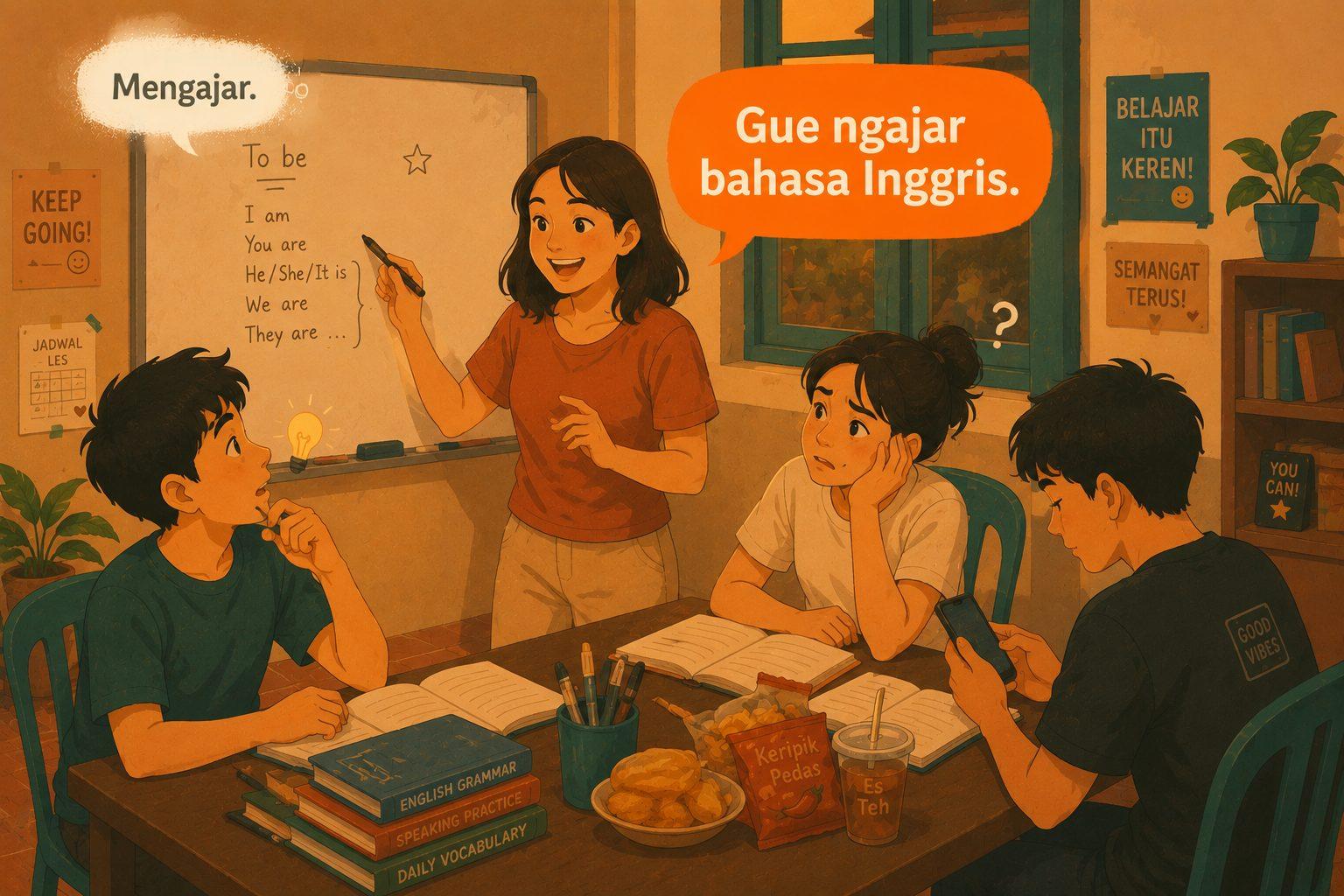
How to Say Mengajar in Casual Indonesian (Hint: It's Ngajar)
Your textbook says "mengajar." Your Indonesian friend says "ngajar." Welcome to real life.
This is one of those words that instantly separates textbook speakers from people who actually live here. I heard it my first week in Jakarta. A guy at a warung told me, "Gue ngajar di SMA" (I teach at a high school). Not mengajar. Ngajar.
I nodded like I understood. I did not understand.
The Me- Drop
Here's what's happening. In casual Indonesian, the me- prefix gets dropped. A lot. Mengajar becomes ngajar. Membantu becomes ngebantu. Membaca becomes.. baca.
It's not random. It's not wrong. It's just how people talk.
Formal: Saya mengajar bahasa Inggris. Casual: Gue ngajar bahasa Inggris.
Same meaning. Totally different vibe. The first one sounds like you're reading from a government document. The second sounds like you're a human being having a conversation.
If you walk into a teacher's lounge in Indonesia and say "Saya mengajar matematika," nobody will correct you. But they'll know. They'll know you learned Indonesian from a book.
Ngajar in the Wild
Let me give you some real examples. Stuff you'd actually hear on the street.
"Gue ngajar les privat tiap Sabtu." (I teach private tutoring every Saturday.)
"Dia ngajar apa sih?" (What does she teach?)
"Males banget ngajar hari ini." (Really don't feel like teaching today.)
"Lo ngajar di mana sekarang?" (Where do you teach now?)
See how natural that sounds? No me- prefix in sight. That's Jakarta Indonesian for you. And honestly, most casual Indonesian across the country works the same way.
The Education Vocab You Actually Need
Okay. Let's go beyond ngajar. If you're talking about education in casual Indonesian, here's what you need to know.
Belajar (Study / Learn)
This one stays mostly the same in casual speech. You might hear "blajar" sometimes — that's the super lazy pronunciation. But "belajar" is already pretty casual.
"Gue lagi belajar bahasa Jepang." (I'm studying Japanese.)
"Belajar yang bener dong!" (Study properly!)
Les (Tutoring / Private Class)
This is huge. Absolutely huge. If you don't know "les," you're missing a massive part of Indonesian culture.
Les means private tutoring or extra classes outside school. And in Indonesia.. it's basically an industry. Parents send their kids to les for everything. Math. English. Piano. Swimming. You name it.
"Anak gue les bahasa Inggris." (My kid takes English tutoring.)
"Lo masih ngajar les?" (Do you still teach tutoring?)
The full phrase is "les privat" — private lessons. Every neighborhood has someone offering les privat from their home. Students going door to door for lessons. Teachers earning side income after school. It's a whole ecosystem.
Guru (Teacher)
Guru means teacher. You probably knew that. But here's what the textbook doesn't tell you — it gets used way more loosely in daily life.
"Guru gue galak banget." (My teacher is super strict.)
"Dia guru les gue." (She's my tutoring teacher.)
Sometimes you'll hear "bu guru" (female teacher) or "pak guru" (male teacher) used almost like nicknames. Kids yell "Pak Guruuuu!" across the school yard. It's endearing.
Murid (Student)
Murid is student. Simple. You'll also hear "anak didik" in formal contexts, but in casual conversation, murid is the go-to.
"Murid gue banyak banget semester ini." (I have so many students this semester.)
"Dia murid paling pinter di kelas." (She's the smartest student in class.)
For university students, people usually say "mahasiswa" (male) or "mahasiswi" (female). In casual speech, just "mahasiswa" for everyone.
Kursus (Course)
Kursus is a course or class you take outside formal education. Think language courses, computer courses, cooking classes.
"Gue ikut kursus masak." (I'm taking a cooking course.)
"Kursus bahasa Inggris di mana yang bagus?" (Where's a good English course?)
The difference between les and kursus? Les is usually one-on-one or small group, often at someone's house. Kursus is more structured, at a dedicated place. But people mix them up constantly. Don't stress about it.
Bimbel Culture 🎓
Now let's talk about bimbel. Short for "bimbingan belajar" — study guidance. This is Indonesia's version of cram schools.
Bimbel is massive. Companies like Primagama, Ganesha Operation, Ruangguru — they're household names. Every Indonesian student knows what bimbel is. Many have spent years inside one.
The purpose? Prepare for exams. Especially the university entrance exam. Parents pour serious money into bimbel. It's not optional in many families. It's expected.
"Lo ikut bimbel apa?" (Which bimbel do you go to?)
"Bimbel gue mahal banget tapi worth it sih." (My bimbel is super expensive but worth it.)
I talked to a high school teacher once in Bandung. She told me most of her students go to bimbel after school. Every day. School from 7 to 2, then bimbel from 3 to 6. Some do les privat on top of that. These kids are grinding.
It says a lot about how seriously Indonesians take education. The formal system, the informal system, the private system — they all run in parallel. And the casual language around all of it is what you need if you want to actually talk to people about their lives.
Formal vs. Casual: A Quick Cheat Sheet
| Formal | Casual | Meaning |
|---|---|---|
| Saya mengajar | Gue ngajar | I teach |
| Saya belajar | Gue belajar | I study |
| mengikuti kursus | ikut kursus | take a course |
| bimbingan belajar | bimbel | cram school |
| les privat | les | private tutoring |
| murid-murid saya | murid-murid gue | my students |
Why This Matters
Look. You can survive in Indonesia with formal Indonesian. People will understand you. They'll be polite about it.
But you'll sound like a news anchor at a dinner party.
The moment you say "Gue ngajar bahasa Inggris" instead of "Saya mengajar bahasa Inggris," something shifts. People relax. They switch out of "talking to a foreigner" mode. They start talking to you like a person.
That's the whole point. 🔑
The me- prefix drop isn't slang, really. It's just.. spoken Indonesian. The version 270 million people actually use when they're not writing an essay or giving a speech.
Try It
Next time you're talking to an Indonesian friend, drop the me- prefix. Say "ngajar" instead of "mengajar." Say "nonton" instead of "menonton." Say "ngomong" instead of "mengemong."
Watch their face. They'll probably smile. Maybe laugh. Definitely respect the effort. 😄
And if you're a teacher in Indonesia — or you've ever taken les privat — I want to hear about it.
What's your experience with education culture in Indonesia? Drop a comment below. 👇
Keep learning
Related articles
How to Say Memotong in Casual Indonesian: Just Say Motong
Nobody says memotong in real life. Learn how Indonesians actually say 'to cut' using motong, potong, and all the slang variations you'll hear daily on the streets.

How to Say 'Oleh Karena Itu' in Casual Indonesian (Hint: Nobody Says That)
Stop sounding like a textbook. Learn the casual Indonesian connectors real people use — makanya, jadinya, terus, abis itu, soalnya, biar — and ditch oleh karena itu forever.
How to Say Mengantar in Casual Indonesian
Nobody in Indonesia actually says mengantar. Learn the casual forms — ngantar, antar, anterin — and how ojek and delivery culture made this one of the most-used verbs in daily life.