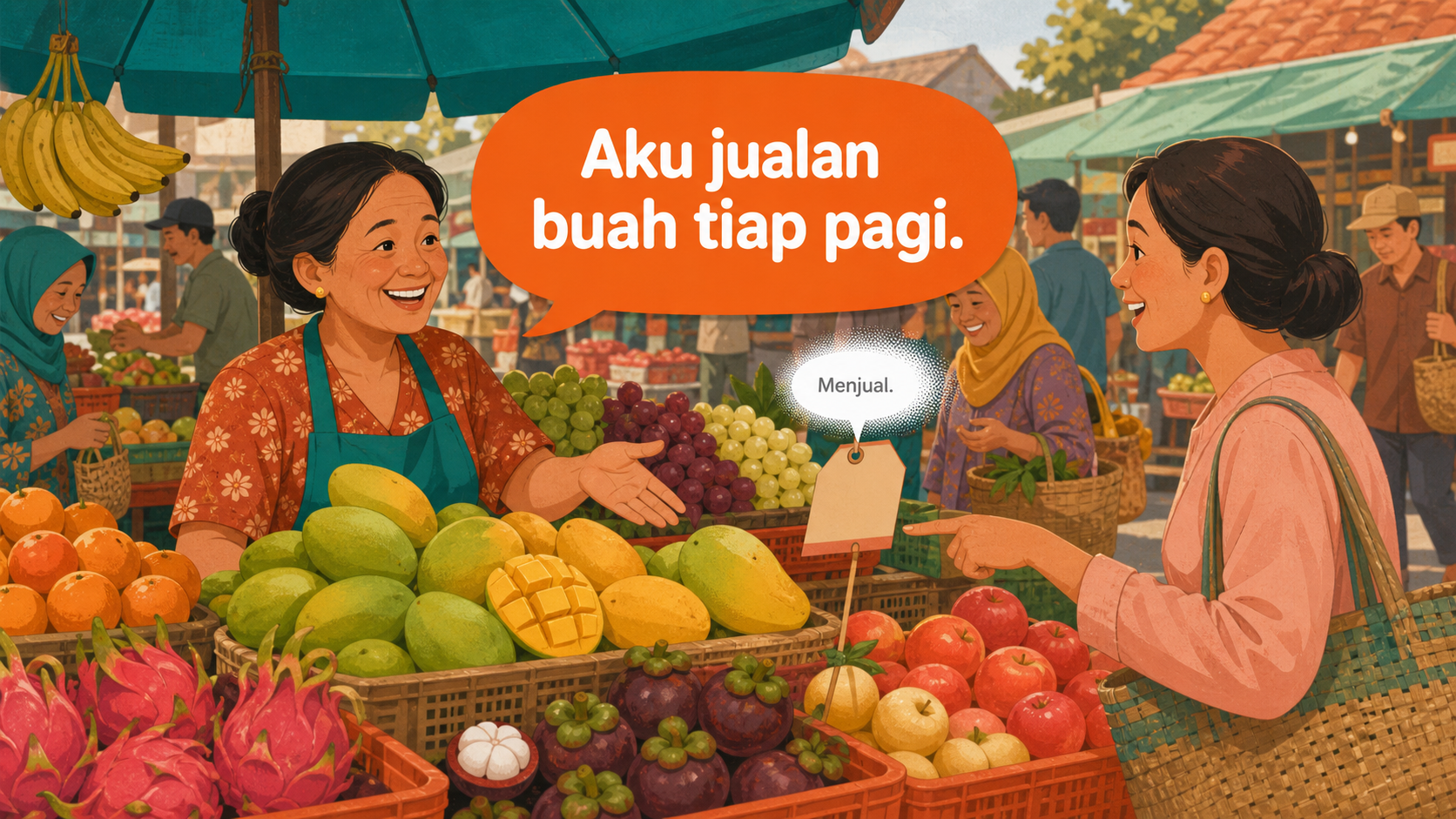
How to Say Menjual in Casual Indonesian: Jual, Jualan, and the Art of Selling Everything
Your textbook taught you menjual.
Nobody says that.
I mean.. technically people understand it. You'll see it in news articles and government documents. But in actual conversation? On the street? In WhatsApp chats? Nah.
The word you need is jual.
The Real Word: Jual
Indonesian has this beautiful pattern where formal prefixes just.. disappear in casual speech. Menjual becomes jual. Membeli becomes beli. Mengatakan becomes bilang. The language breathes easier without all that formality.
So if you're at a pasar (market) and you want to ask someone what they're selling, you don't say "Anda menjual apa?" You say:
"Jual apa?" (What are you selling?)
That's it. Two words. Done.
I remember walking through Pasar Santa in Jakarta the first time. Every few steps someone would call out what they had. "Jual kopi!" "Jual baju vintage!" No prefixes. No formality. Just the thing and the action.
Jualan: The Word That Runs Indonesia
Now here's where it gets interesting. Take jual, add the suffix -an, and you get jualan. This word is everywhere.
Jualan works as both a verb and a noun. It means "selling stuff" or "the stuff being sold." Context does the heavy lifting.
"Gue jualan online." (I sell stuff online.)
"Jualan lu apa?" (What do you sell? / What's your product?)
"Lagi jualan nih." (I'm selling stuff right now.)
That last one? You'll hear it constantly. Indonesia has this incredible culture where practically everyone has a side hustle. Your Grab driver sells phone cases. Your coworker sells homemade sambal on Instagram. Your neighbor runs a small warung out of their front room.
Jualan isn't just a word. It's a lifestyle. 🔥
The Tokopedia and Shopee Universe
You cannot talk about jualan in Indonesia without talking about e-commerce. Tokopedia. Shopee. Bukalapak. These platforms turned the entire country into a marketplace.
Open Instagram in Indonesia and every third story is someone promoting their jualan. Skincare. Snacks. Custom phone cases. Hijabs. Handmade jewelry. The entrepreneurial energy is unreal.
Common phrases you'll see everywhere online:
"Dijual murah!" (Selling cheap! / For sale, cheap!)
"Jual rugi" (Selling at a loss. Sometimes true. Often marketing.)
"Jual cepat" (Quick sale. They want it gone.)
"Ready stock, langsung jual" (In stock, selling now.)
The word dijual deserves its own moment. It's the passive form. "Being sold." You'll see it on signs, posts, listings. A house with a sign out front? DIJUAL. A car listing? DIJUAL. It's the Indonesian equivalent of "FOR SALE" and you'll spot it on every block in every city.
Pasar Culture and the Art of Jual-Beli
Indonesia's relationship with buying and selling goes deep. The phrase jual-beli (buying and selling, trade, commerce) is fundamental to daily life.
Traditional markets. Pasar pagi (morning markets). Pasar malam (night markets). These places are loud, chaotic, beautiful. And the language there is stripped down to pure function.
"Jual berapa?" (How much are you selling this for?)
"Jual satuan bisa?" (Can you sell individual pieces?)
"Jualnya mahal banget!" (You're selling it so expensive!)
That last phrase.. you'll use it a lot. Bargaining is an art form in Indonesia. The seller starts high. You counter low. You both know the real price is somewhere in the middle. But you play the game anyway. It's almost rude not to.
I once spent fifteen minutes negotiating the price of a batik shirt in Yogya. The seller started at 200,000 rupiah. I ended up paying 80,000. We were both smiling at the end. That's jual-beli. That's the culture.
Jual Mahal: When Selling Gets Figurative
Here's my favorite use of jual. 😄
Jual mahal literally means "sell expensive." But figuratively? It means playing hard to get.
"Dia jual mahal." (She's/He's playing hard to get.)
"Jangan jual mahal lah." (Don't play hard to get, come on.)
It works for people. For negotiations. For that friend who won't commit to weekend plans. Someone being difficult about saying yes? They're jual mahal.
There's also jual diri which.. well, that one can go a couple of directions depending on context. It can mean "selling yourself" in the professional sense. Marketing yourself. Personal branding. Or it can mean something less flattering. Read the room on that one.
Everyone Has Something to Sell
What struck me most about Indonesia is this. The hustle is universal. It's not desperation. It's culture. It's energy. It's the belief that you can always make a little extra on the side.
Your ojol (motorcycle taxi) driver asks if you want to buy pulsa (phone credit). He's jualan. A university student posts her handmade earrings on Shopee between classes. She's jualan. A retired ibu in your kampung makes kue (cakes) every morning and sells them from her window. She's jualan.
The word for this kind of seller is penjual (seller) in formal Indonesian. But casually? People just say:
"Yang jualan" (the one who sells / the seller)
"Tukang jual" (seller, vendor. More informal.)
Or for online sellers specifically: "seller" — yep, they just use the English word. Indonesian absorbs English terms for e-commerce the way it absorbs everything else. Naturally. Without fuss.
Quick Reference: Jual in All Its Forms
Let me break down the family:
- Jual — sell (casual form of menjual)
- Jualan — selling stuff / the stuff being sold / side hustle
- Dijual — for sale / being sold
- Jual murah — selling cheap
- Jual mahal — selling expensive / playing hard to get
- Jual-beli — buying and selling, commerce
- Penjual — seller (formal)
- Jual rugi — selling at a loss
- Jual cepat — quick sale
- Jual habis — sold out (sold until gone)
The Takeaway
Forget menjual. Seriously. File it away in the "I know this exists but I'll never use it" folder alongside whom and hitherto.
In real Indonesian life, jual is the word. Jualan is the culture. And dijual is on every sign, every listing, every Instagram story.
Indonesia is a nation of entrepreneurs. From the warung on the corner to the Shopee mega-seller with 50,000 reviews. Everyone's got something to offer. Everyone's jualan.
Next time you're in Indonesia and someone asks what you do, try this:
"Gue jualan [your thing]." 🙌
Watch how fast the conversation opens up. Suddenly you're not a tourist. You're someone who gets it.
So.. what are you jualan? Drop it in the comments. I'm curious what my readers are selling out there.
Keep learning
Related articles
How to Say Menerima in Casual Indonesian: Terima, Nerima, and Why Online Shopping Made It Essential
Learn how Indonesians actually say 'menerima' in everyday conversation. Hint: nobody says menerima. It's terima or nerima — and thanks to Shopee and Tokopedia, you'll hear it everywhere.
How to Say Membuang in Casual Indonesian
Membuang is textbook Indonesian. Real people say buang. Learn how Indonesians actually use buang in everyday conversation — from throwing trash to bathroom euphemisms.

How to Say 'Mohon' in Casual Indonesian (Hint: You Don't)
Mohon is way too formal for everyday Indonesian. Learn the casual alternatives — tolong, dong, and the -in + dong pattern that makes any verb a friendly request.