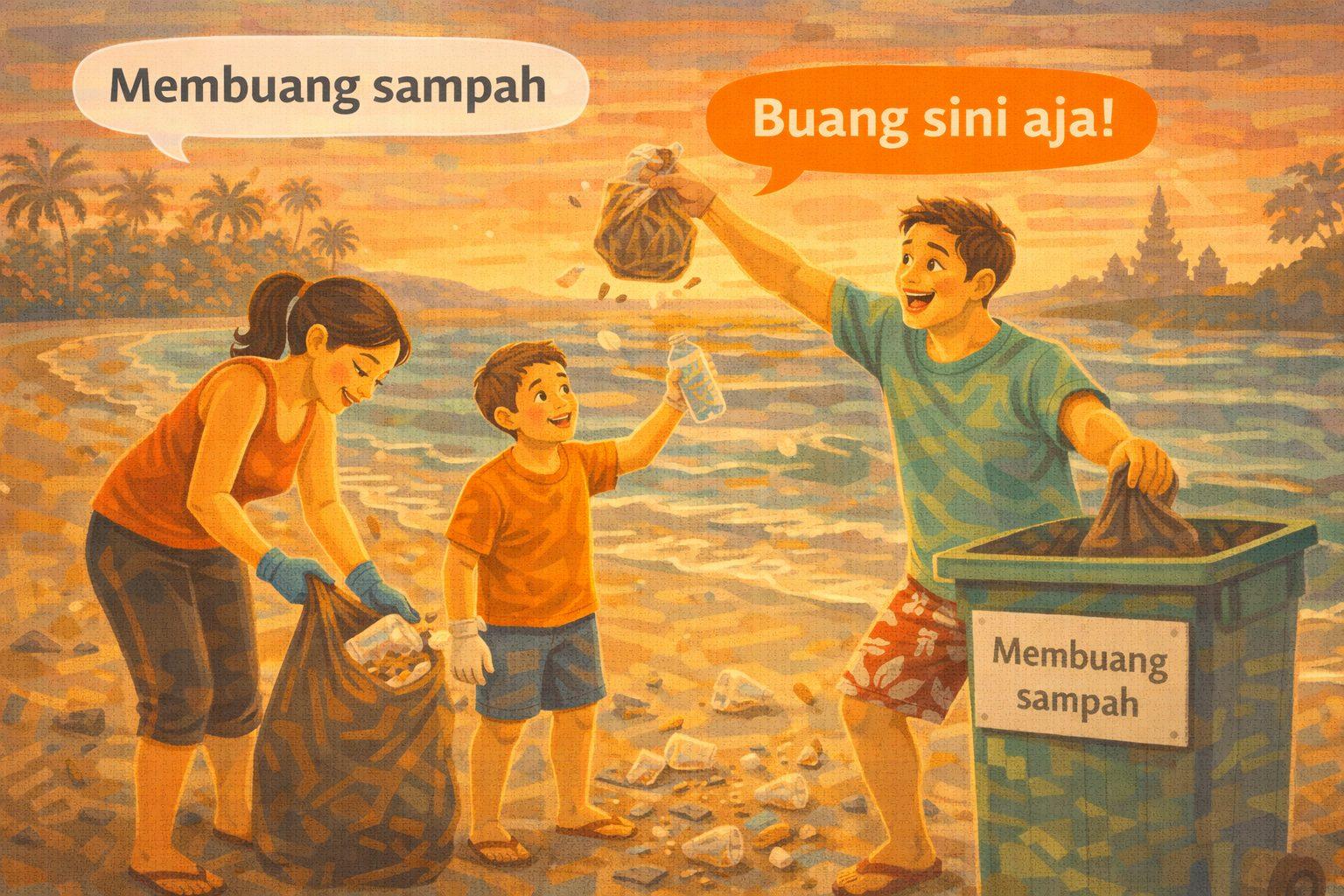
How to Say Membuang in Casual Indonesian
Your textbook taught you membuang. Nobody says that.
Well.. almost nobody. You might hear it in a presidential speech. Or a news broadcast. But on the street? At the warung? With your friends? It's just buang.
That's it. Drop the me- prefix. Done.
This is one of those Indonesian patterns that trips up learners hard. You study the formal form. You memorize it. You use it in conversation. And your Indonesian friend gives you that polite smile that secretly means "you sound like a walking dictionary."
I learned this the hard way in Jakarta. I told someone "Saya ingin membuang ini" while holding an empty coffee cup. They understood me fine. But I might as well have been wearing a sign that said TOURIST.
The me- Drop
Quick grammar detour. In casual Indonesian, the me- prefix on verbs gets dropped constantly. Membuang becomes buang. Membeli becomes beli. Membuat becomes buat. This isn't slang exactly. It's just how people talk.
Think of it like English contractions. "I would like to" vs "I'd like to." Same meaning. Different register. If you always speak without contractions, people notice. Same deal here.
So buang is your word. Let's see what you can do with it.
Buang Sampah — Throw Away Trash
The most basic usage. Sampah means trash or garbage.
Buang sampah di tempatnya. (Throw your trash in its place.)
You will see this sentence everywhere in Indonesia. On signs. On walls. On trash cans. It's the national mantra for waste disposal. And honestly.. Indonesia needs it.
The full anti-littering phrase you'll spot on signs is:
Dilarang buang sampah sembarangan. (It is forbidden to throw trash carelessly / No littering.)
Sembarangan means carelessly, recklessly, just anywhere. This sign is so common it might be the first full Indonesian sentence you actually read in the wild. Painted on walls in neighborhoods. Printed on municipal signs. Stuck to poles near rivers.
Indonesia has a real relationship with trash. If you've been to Bali or Java, you know. The country is beautiful but fighting a massive waste problem. There's a growing environmental movement, especially among younger Indonesians. Organizations like the Bali-based Sungai Watch pull literal tons of plastic from rivers. The phrase buang sampah pada tempatnya isn't just a sign. It's a cultural battle cry.
You'll also hear:
Buang di sini. (Throw it away here.)
Jangan dibuang! (Don't throw it away!)
Simple. Direct. No membuang in sight.
Buang Air — The Bathroom Euphemism 🚽
This one is gold.
Buang air literally means "throw away water." But it actually means.. go to the bathroom.
Yep. Indonesians say they're "throwing water" when they need to pee. And it gets more specific:
Buang air kecil — literally "throw small water" — means to urinate.
Buang air besar — literally "throw big water" — means.. well. You get it.
I remember the first time I heard this. I was at a friend's house in Bandung. Someone said "Mau buang air dulu" (I want to go to the bathroom first) and I sat there confused, thinking they were going to pour water out somewhere. My friend had to explain it to me while trying not to laugh.
It's a euphemism. Every language has bathroom euphemisms. English says "use the restroom" — you're not resting. Indonesian says "throw water" — equally weird if you think about it literally.
In casual conversation, people often shorten it further:
Mau ke toilet, buang air dulu. (Going to the toilet, need to use the bathroom first.)
Or sometimes just buang air alone is enough and everyone understands.
This phrase isn't slang, by the way. It's standard Indonesian. Doctors use it. Forms at hospitals ask about your buang air besar. It's the normal, polite way to discuss bodily functions. But knowing it makes you sound way more natural than fumbling around with English loanwords.
Buang Waktu — Waste Time
Here's another common combo. Waktu means time.
Jangan buang waktu. (Don't waste time.)
Itu cuma buang-buang waktu. (That's just wasting time.)
Notice the reduplication there. Buang-buang adds emphasis. It implies doing something repeatedly or excessively. "Wasting and wasting." It carries a tone of frustration.
You might hear this at work:
Meeting tadi buang-buang waktu aja. (That meeting was just a waste of time.)
Aja is casual for saja (just/only). Stack the casual forms. That's how real speech works.
Or from a parent:
Kamu buang-buang waktu main HP terus. (You keep wasting time playing on your phone.)
HP (pronounced "ha-pe") means handphone. Mobile phone. Another essential Indonesian vocabulary word if you want to sound like you belong.
Jangan Buang-Buang — Don't Waste
The reduplicated form buang-buang works as a general "don't waste" construction.
Jangan buang-buang uang. (Don't waste money.)
Jangan buang-buang makanan. (Don't waste food.)
Jangan buang-buang tenaga. (Don't waste energy/effort.)
This is the Indonesian equivalent of your mom telling you to appreciate what you have. You'll hear it a lot. Indonesian culture values resourcefulness. Not wasting things is a deeply held principle, especially among older generations.
In my experience, hearing jangan buang-buang from an Indonesian friend means they genuinely care about you. It's advice wrapped in directness. No sugar coating.
Buang Muka — Turn Away Your Face 😤
One more good one. Muka means face.
Dia buang muka. (He/she turned away / looked away deliberately.)
This implies someone is ignoring you. Turning their face away on purpose. Cold shoulder energy. It's not about literally throwing a face somewhere. It's about rejection or avoidance.
Waktu aku sapa, dia malah buang muka. (When I greeted him, he actually turned away.)
Malah is a fantastic word meaning "instead" or "actually" with a tone of surprise or frustration. Great word to stack with buang muka for maximum dramatic effect.
Quick Reference
| Formal | Casual | Meaning |
|---|---|---|
| membuang sampah | buang sampah | throw away trash |
| membuang air | buang air | go to the bathroom |
| membuang waktu | buang waktu | waste time |
| membuang-buang | buang-buang | waste (repeatedly) |
| membuang muka | buang muka | look away, ignore |
The Pattern to Remember
Drop the me-. That's it. That's the whole lesson.
Membuang → buang. In every context. Formal writing keeps the prefix. Conversation drops it. Once you internalize this, you'll start hearing it everywhere. And you'll start dropping me- from other verbs too. Membeli → beli. Menulis → nulis. Memasak → masak.
Your Indonesian will go from textbook-correct to actually-natural. And that's not a small thing. That's the difference between being understood and being one of us.
Start with buang. Use it tomorrow. Tell someone jangan buang-buang waktu and watch their face light up. 🔥
What's the first me- prefix verb you learned in Indonesian that you later realized nobody actually says in conversation?
Keep learning
Related articles
How to Say Menerima in Casual Indonesian: Terima, Nerima, and Why Online Shopping Made It Essential
Learn how Indonesians actually say 'menerima' in everyday conversation. Hint: nobody says menerima. It's terima or nerima — and thanks to Shopee and Tokopedia, you'll hear it everywhere.

How to Say Menjual in Casual Indonesian: Jual, Jualan, and the Art of Selling Everything
Learn how Indonesians actually say 'menjual' in everyday conversation. Spoiler: nobody says menjual. It's jual, jualan, dijual — and it's everywhere.

How to Say 'Mohon' in Casual Indonesian (Hint: You Don't)
Mohon is way too formal for everyday Indonesian. Learn the casual alternatives — tolong, dong, and the -in + dong pattern that makes any verb a friendly request.