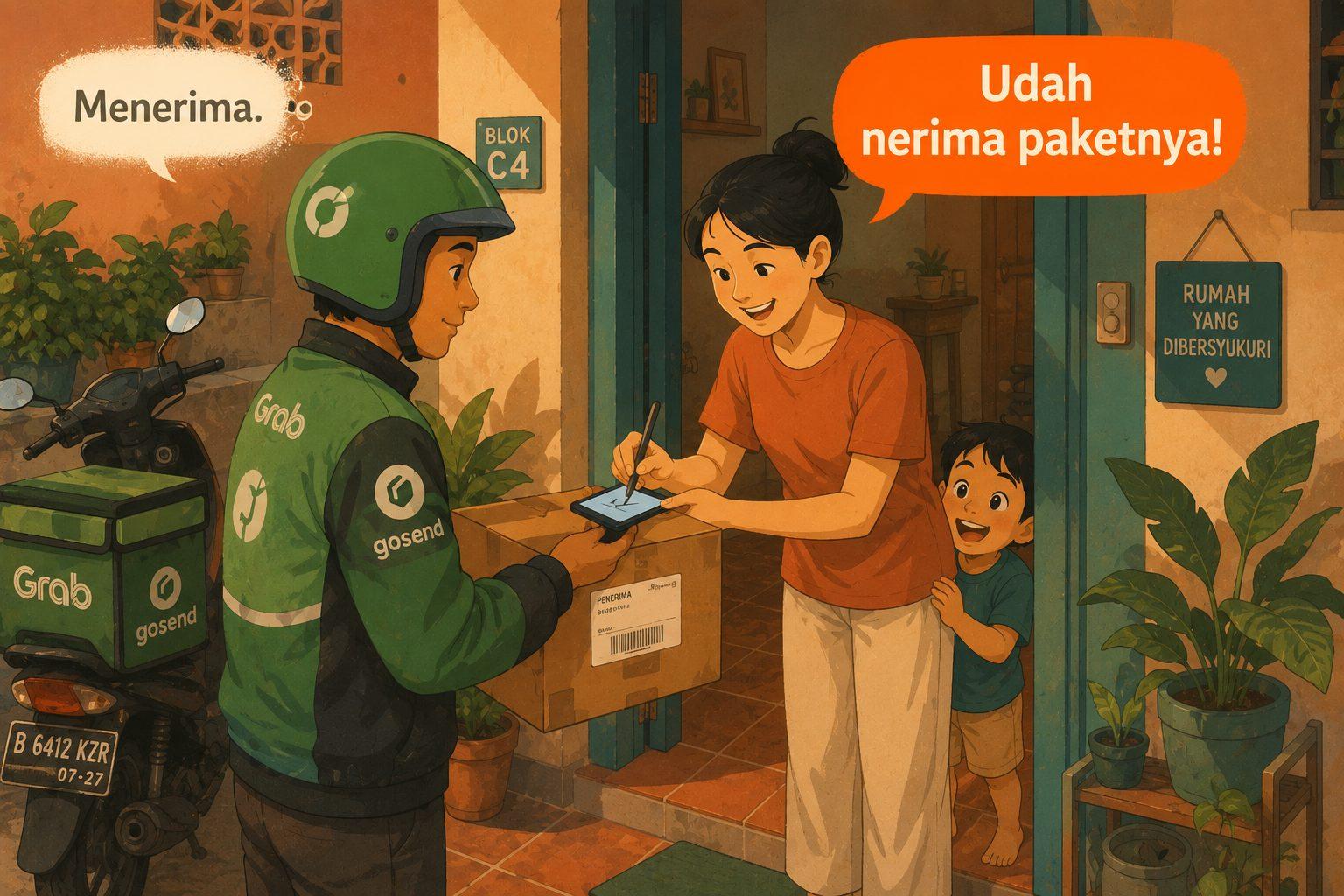
How to Say Menerima in Casual Indonesian: Terima, Nerima, and Why Online Shopping Made It Essential
Nobody says "menerima."
I mean.. technically it's correct. Your textbook will teach it. Your Duolingo course will drill it. But walk into any warung in Jakarta and say "Saya menerima paket kemarin" and people will look at you like you're reading a government press release out loud.
The real word? Nerima. Or just terima.
The Prefix Drop That Changes Everything
Indonesian has this beautiful pattern. Formal verbs with the me- prefix get stripped down in casual speech. Mengerti becomes ngerti. Menunggu becomes nunggu. Membeli becomes beli.
And menerima? It becomes nerima. Or sometimes just terima.
This isn't slang. This isn't "wrong" Indonesian. This is how 270 million people actually talk. Every day. In every city. On every WhatsApp chat.
I learned this the hard way. Spent months in Bandung using full formal prefixes in conversation. People understood me fine. But I sounded like a news anchor ordering nasi goreng. Not great.
Nerima Paket: The Phrase You'll Hear Every Single Day
Indonesia had an e-commerce explosion. Tokopedia. Shopee. Lazada. Blibli. The country went from cash-at-the-market to tapping phones and waiting for packages. Fast.
And with that came a phrase you now hear constantly:
"Udah nerima paket belum?" (Have you received the package yet?)
This is everywhere. Literally everywhere. Your kos-kosan neighbor asks it. The security guard at your apartment asks it. The WhatsApp group chat for your building is 90% some version of this question.
Some variations you'll encounter:
- "Paketnya udah diterima?" (Has the package been received?)
- "Siapa yang nerima paket gue?" (Who received my package?)
- "Gue belum nerima apa-apa." (I haven't received anything yet.)
Notice how nobody says "menerima" in any of these. Not once. The me- prefix just.. vanishes.
If you're living in Indonesia and ordering stuff online (you will, it's addictive), you need this phrase in your bones. The kurir (courier) will call you. They'll text you. And you'll need to confirm: "Udah diterima, makasih." (Already received, thanks.)
Nerima Tamu: Receiving Guests
Beyond packages, nerima tamu is a phrase you'll hear in more traditional or family contexts.
"Kita harus nerima tamu dulu." (We need to receive the guests first.)
This one carries weight. Indonesian hospitality is serious. Receiving guests isn't just opening the door. It's preparing drinks. Snacks. Making sure the living room looks good. The word nerima here has warmth to it. Welcoming. Accepting someone into your space.
In more formal settings, like a wedding or official event, you might hear menerima tamu with the full prefix. But at home? Among family? It's always nerima.
"Siapa yang nerima tamu tadi?" (Who received the guests earlier?)
"Mamah lagi nerima tamu, jangan berisik." (Mom is receiving guests, don't be noisy.)
That last one.. I heard it approximately six thousand times in my neighbor's house in Jogja. 😄
Terima Kasih → Makasih: The Connection You Already Know
Here's something cool. You probably already know terima kasih (thank you). And you probably already know the casual version: makasih.
See what happened there? The terima got shortened too. Terima kasih → makasih. The same casualization pattern.
And if you break down terima kasih literally, it means "receive love" or "receive gratitude." So when you say makasih, you're using the same root word. Terima. Receive.
This connection helps it stick. Every time you say makasih (which is.. probably fifty times a day in Indonesia), you're practicing the casual form of terima.
Some other combos with terima kasih you'll hear:
- "Makasih banyak ya!" (Thanks a lot!)
- "Makasih udah mau dateng." (Thanks for coming.)
- "Makasih, paketnya udah gue terima." (Thanks, I've received the package.)
Terima as "Accept": The Emotional Side
Terima and nerima don't just mean "receive" physically. They also mean "accept." And this is where it gets interesting.
"Gue gak bisa nerima ini." (I can't accept this.)
This hits different. Someone might say it about a breakup. A decision at work. Bad news. It's emotional. Raw. And again, nobody says "menerima" here. It's nerima or terima.
More examples:
"Terima aja." (Just accept it.)
This one is pure Indonesian philosophy in two words. Things are rough? Terima aja. Life isn't fair? Terima aja. Your Grab driver took the longest possible route? Terima aja.
It's not passive. It's practical. Indonesians use this as genuine advice. Sometimes with a resigned sigh. Sometimes with a laugh. Always with the understanding that fighting everything is exhausting.
"Susah nerima kenyataan." (It's hard to accept reality.)
"Dia udah nerima keputusan itu." (She's already accepted that decision.)
I once had a friend tell me "Lo harus bisa nerima" after I complained about Jakarta traffic for the fifteenth time. He was right. 🤷
Quick Reference: Formal vs. Casual
| Formal | Casual | Meaning |
|---|---|---|
| menerima paket | nerima paket | receive a package |
| menerima tamu | nerima tamu | receive guests |
| menerima kasih | makasih | thanks |
| tidak bisa menerima | gak bisa nerima | can't accept |
| sudah diterima | udah diterima | already received |
| menerima kenyataan | nerima kenyataan | accept reality |
When to Actually Use "Menerima"
Okay so.. is "menerima" completely dead? No. You'll still see it in:
- News broadcasts
- Official documents
- Formal speeches
- Academic writing
- Job interviews (maybe)
But in conversation? In texts? On social media? It's nerima or terima. Every time.
The rule is simple. If you're talking to a human being in a normal situation, drop the me- prefix. If you're writing a government report, keep it. That's basically it.
The Shortcut That Helps
Here's a pattern that works for dozens of Indonesian verbs. Not just menerima.
me- prefix → drop it.
- Mengerti → ngerti (understand)
- Membantu → bantu (help)
- Membuat → bikin (make)
- Menunggu → nunggu (wait)
- Menerima → nerima (receive)
Once you internalize this pattern, casual Indonesian unlocks fast. You stop sounding like a textbook and start sounding like a person. 🔑
The me- drop is probably the single highest-impact change you can make to sound more natural. Higher than learning slang. Higher than perfecting your accent. Just.. stop using the formal prefix in conversation.
Try It Today
Next time you order something on Shopee (and you will, because the flash sales are unreasonable), try this with the kurir or your building security:
"Makasih ya, paketnya udah gue terima." (Thanks, I've already received the package.)
Clean. Natural. No textbook vibes.
What casual Indonesian word did you learn that made you feel like you finally "got it"? Drop it below. I'm always looking for more of those moments. 👇
Keep learning
Related articles

How to Say Membuang in Casual Indonesian
Membuang is textbook Indonesian. Real people say buang. Learn how Indonesians actually use buang in everyday conversation — from throwing trash to bathroom euphemisms.

How to Say Menjual in Casual Indonesian: Jual, Jualan, and the Art of Selling Everything
Learn how Indonesians actually say 'menjual' in everyday conversation. Spoiler: nobody says menjual. It's jual, jualan, dijual — and it's everywhere.

How to Say 'Mohon' in Casual Indonesian (Hint: You Don't)
Mohon is way too formal for everyday Indonesian. Learn the casual alternatives — tolong, dong, and the -in + dong pattern that makes any verb a friendly request.