Small Talk in Indonesian: What Locals Actually Say
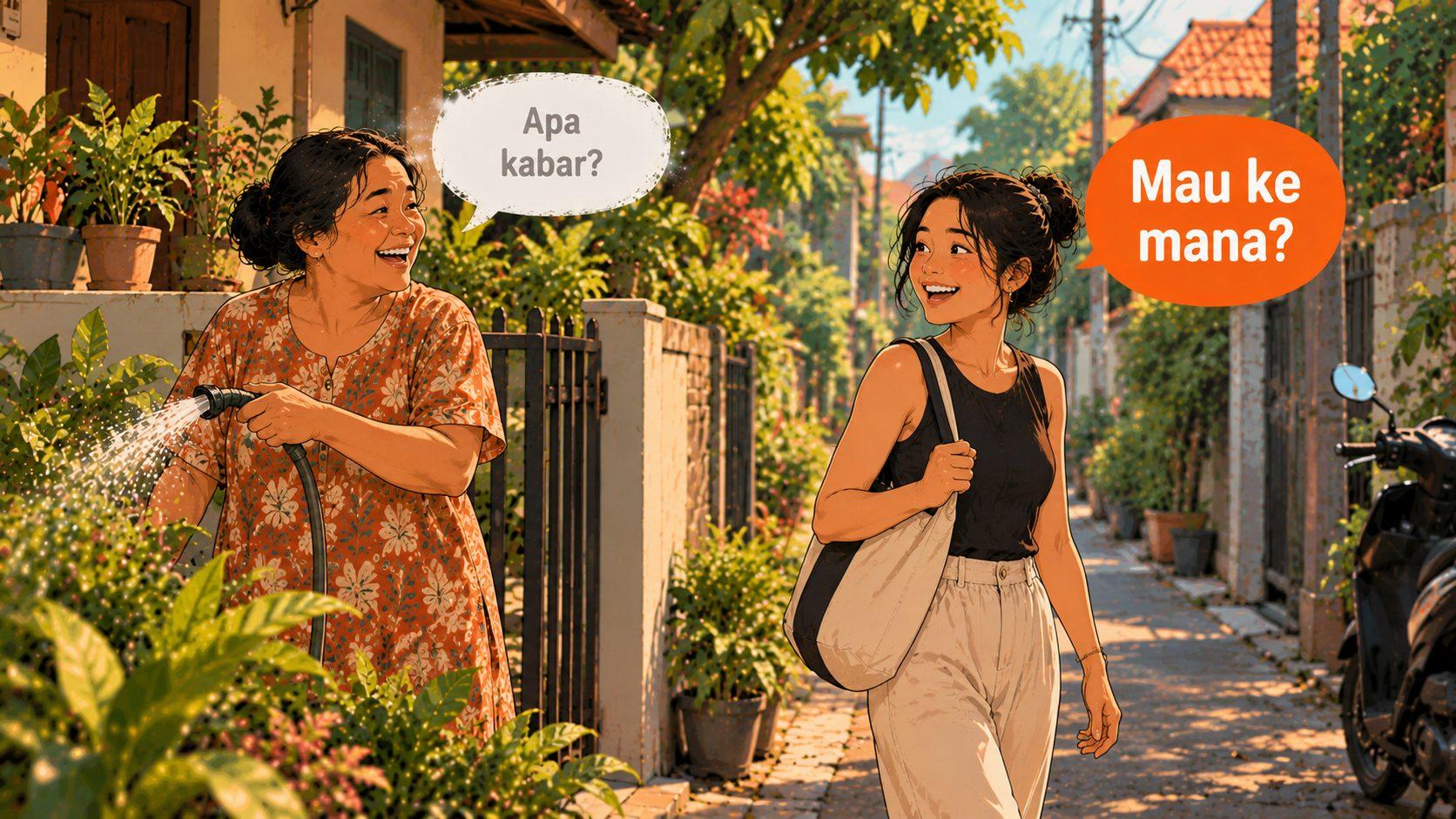
If you learned Indonesian from a textbook, your go-to greeting is probably "Apa kabar?" (How are you?). It works. But it's.. not really how most Indonesians kick off casual conversation.
Indonesian small talk hits different from Western small talk. It's more personal. More direct. Nobody talks about the weather. Instead, people ask where you're going, whether you've eaten, or if you're married. Within the first thirty seconds.
Let's break it down.
The Real Openers
These are the phrases you'll hear every single day. On the street, at the warung, from your neighbor, from the ojek driver.
- "Mau ke mana?" = Where are you going?
- "Dari mana?" = Where are you coming from?
- "Udah makan?" = Have you eaten?
- "Ngapain?" = What are you doing?
- "Lagi apa?" = What are you up to?
"Mau ke mana?" is THE classic. You'll hear it ten times a day. The thing is.. you don't actually need to answer it honestly. It's not an interrogation. It's just a greeting wearing a question's clothes.
How to Answer (Keep It Vague)
Nobody expects a detailed itinerary. Keep it light.
- "Jalan-jalan aja" = Just going around (the universal answer to "Mau ke mana?")
- "Dari rumah" = From home
- "Udah" / "Belom" = Yes / Not yet (for "Udah makan?")
- "Gak ngapa-ngapain" = Not doing anything
That's it. Short and easy. "Jalan-jalan aja" will carry you through 90% of these interactions.
And "Udah makan?" deserves a special note. It's not a literal question about food. It's care. It's concern. It's the Indonesian version of "How are you?" but warmer. If you say "Belom" (not yet), don't be surprised if someone offers to take you to eat.
Topics Indonesians Love
Once you're past the opener, these topics come up fast.
Food. Always food. "Udah makan apa?" (What have you eaten?) is a completely normal follow-up. Indonesians bond over food the way other cultures bond over sports.
Where you're from. If you're a foreigner.. get ready. "Dari mana asalnya?" (Where are you originally from?) will come up in every single conversation. Every one.
Family. "Udah nikah?" (Are you married?) is not considered invasive here. People ask this immediately. Your age, your marital status, how many kids you have. It's all fair game.
Work. "Kerja di mana?" (Where do you work?) follows naturally. It's friendly curiosity, not a background check.
The Culture Shift You Need to Make
Here's where it gets real. Indonesians will casually ask about your age, religion, salary, and whether you have a partner. Things that feel deeply personal in Western culture are.. just normal here. It's not rude. It's not nosy. It's how people place you in their world and figure out how to connect with you.
The worst thing you can do is shut these questions down. A cold "I'd rather not say" creates distance. You don't have to share everything. But respond warmly. Smile. Give a short answer and ask the same question back. That's how connection works here.
Indonesian small talk isn't small at all. It's the gateway to real relationships. People genuinely want to know about your life. Not to judge. To connect.
So next time someone asks "Mau ke mana?" just smile and say "Jalan-jalan aja." You're already doing it right.
What's the most surprising question a stranger in Indonesia has asked you? 🤔
Keep learning
Related articles
Indonesian Code-Switching: When Formal IS Actually Appropriate
We've been pushing casual Indonesian hard. But formal has its place. The real skill is knowing when to switch registers.. and reading the room.

How to Say 'Mengirim' in Casual Indonesian (Kirim, Ngirim)
Mengirim is the textbook word for 'to send' in Indonesian.. but nobody actually says it. Here's how kirim and ngirim work in real life.
How to Say 'Mengatakan' in Casual Indonesian (Bilang, Ngomong)
Mengatakan is the formal Indonesian word for 'to say' or 'to tell.' In real life, everyone just says bilang. Here's how it works and why you'll use it 20 times a day.