
Why Textbook Indonesian Fails You on the Streets of Jakarta
You've done everything right. Duolingo streak intact. Grammar workbook completed. You can conjugate verbs, you know the difference between di- and ke-, and you've memorized hundreds of vocabulary words.
Then you land in Jakarta. You walk up to a warung and confidently order: "Saya ingin memesan nasi goreng."
The vendor stares. Pauses. Then laughs—not unkindly, but with the unmistakable recognition that you are, without question, a foreigner.
What went wrong?
The Textbook Problem
Indonesian language courses teach you bahasa baku—the formal, standardized version of the language. It's correct. It's proper. It's also almost never used in casual conversation.
Here's the thing: Indonesian has two languages hiding inside one. There's the formal register you learn in books, and then there's the colloquial version that 270 million Indonesians actually speak.
Consider these translations of "I want to use that":
| Textbook | Real Life |
|---|---|
| Saya ingin menggunakan itu | Gue mau pake itu |
Both mean the same thing. But the first sounds like you're reading from a government document, while the second sounds like you're actually having a conversation.
Why Courses Keep Teaching Formal
There are a few reasons:
-
Formal is easier to standardize. Teaching colloquial Indonesian means dealing with regional variations. Jakarta slang differs from Surabaya slang. Bali has its own flavor. Textbooks want consistency.
-
It's what foreigners "should" learn. There's a well-meaning assumption that non-native speakers should master formal Indonesian before getting casual. The problem? Most learners never reach the second stage.
-
Written resources are formal. News articles, official documents, literature—they're all in bahasa baku. So that's what gets taught.
The Real-World Consequence
You end up in a strange linguistic uncanny valley. You're technically speaking Indonesian, but every local immediately clocks you as a learner. Not because your pronunciation is wrong (though it might be), but because no one talks like that.
The pronouns are the biggest giveaway:
- Saya → sounds formal, often replaced with gue (Jakarta), aku (general casual), or regional variants
- Anda → basically never used in conversation; people use names, kamu, or lo
- Mereka → shortened to mereka or just orang-orang
Then there's the vocabulary. Menggunakan becomes pake. Bekerja becomes kerja. Berbicara becomes ngomong. The formal prefix-suffix system that textbooks drill into you? Locals drop most of it.
What Actually Works
The solution isn't to throw out everything you learned. Formal Indonesian has its place—writing, official situations, speaking with elders you don't know well.
But if you want to actually connect with people, you need exposure to colloquial speech from day one. You need to hear how locals drop syllables, swap pronouns, and compress phrases.
More importantly, you need real-time feedback when you default to textbook mode. Not a grammar correction five minutes later, but an instant nudge: "Hey, that's formal—try this instead."
That's the core insight behind what we're building with Slangua. Not replacing traditional learning, but adding the layer that's been missing: immediate, contextual coaching that bridges the gap between what you learned and what people actually say.
Because fluency isn't about perfect grammar. It's about sounding human.
Keep learning
Related articles
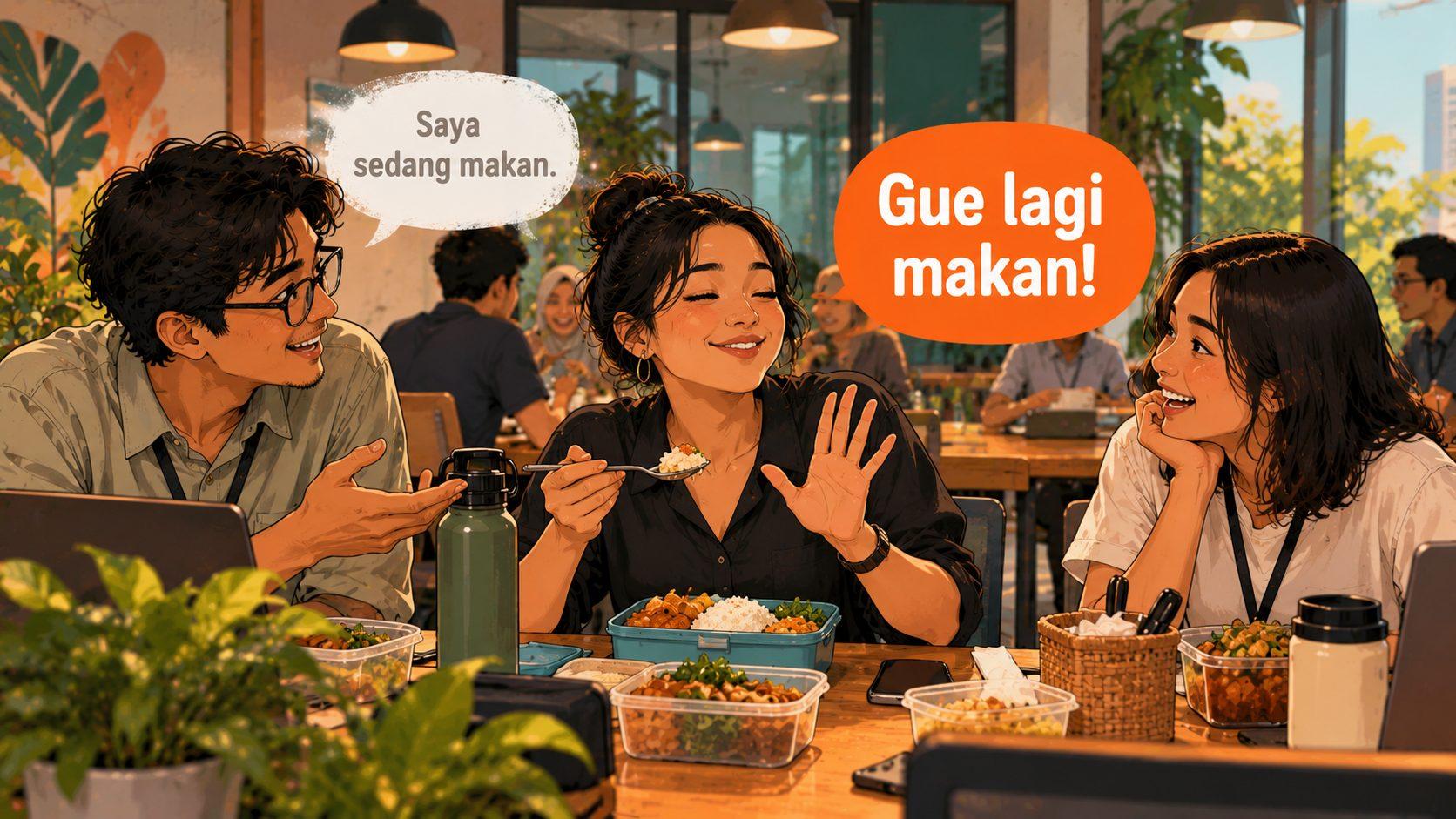
How to Say 'Sedang' in Casual Indonesian (Just Say 'Lagi')
Stop saying 'sedang' in conversation. Learn how Indonesians actually express present continuous tense with 'lagi', one of the most versatile words in casual Indonesian.

How to Say 'Saya' in Casual Indonesian (Gue vs Aku vs Gw)
Saya is formal. Your Indonesian friends don't use it with each other. Learn when to use gue, aku, and gw so you stop sounding like a textbook.

How to Say Pekerjaan in Casual Indonesian (Hint: Nobody Says Pekerjaan)
Learn how Indonesians actually talk about work in everyday conversation. Forget 'pekerjaan' — it's 'kerjaan.' Plus the casual work vocab you need to survive small talk in Jakarta.