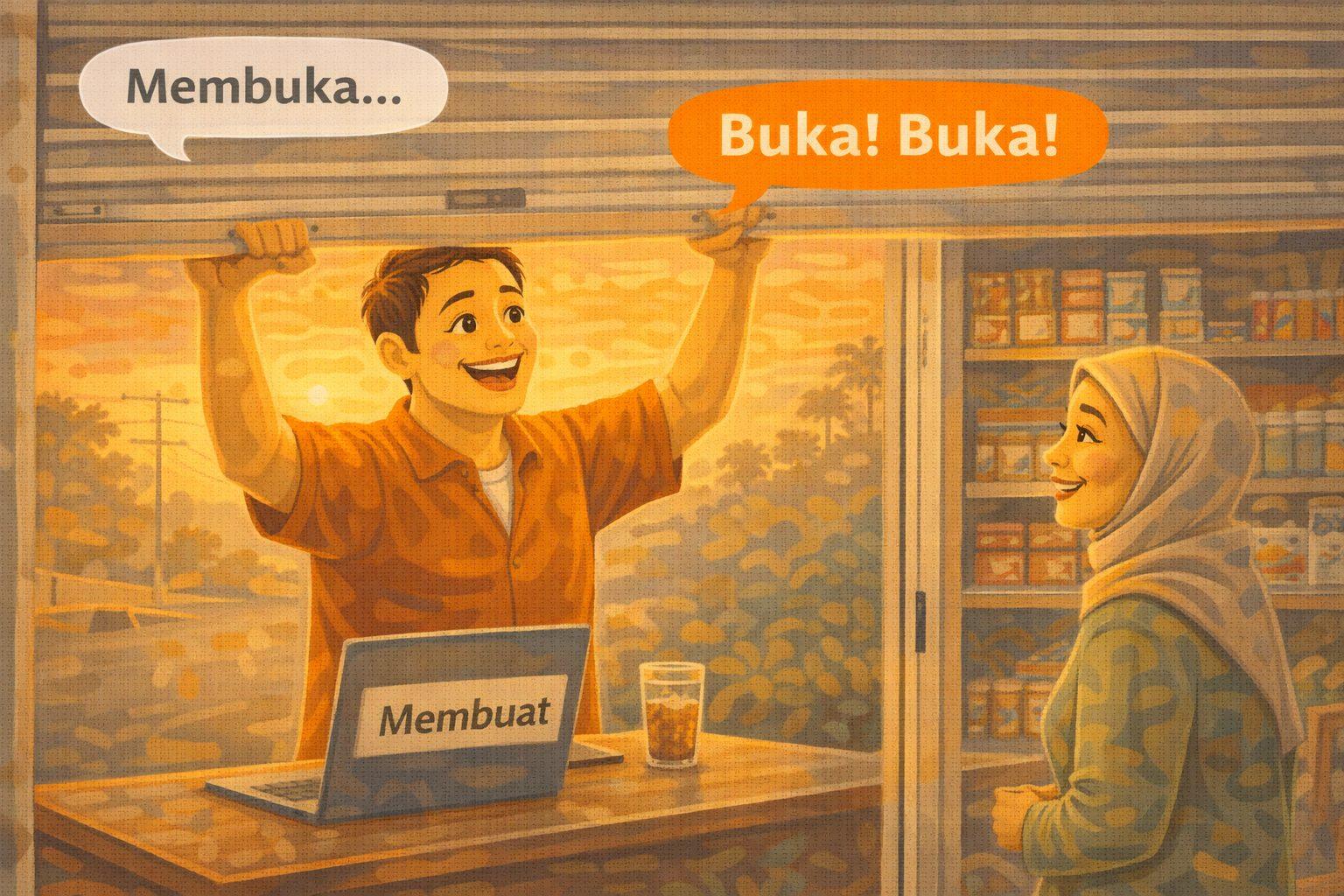
How to Say Membuka in Casual Indonesian: Just Say Buka
Your textbook taught you membuka. Forget it.
Well.. not completely. But if you walk around Jakarta saying "membuka" in everyday conversation, people will understand you. They'll also think you sound like a news anchor.
Nobody talks like a news anchor.
The word you actually need is buka. One word. Two syllables. Used constantly.
I learned this the hard way. I was at a warung in Yogya, trying to ask the owner if the shop was open. I said something painfully formal with membuka. The guy smiled. His friend laughed. "Udah buka, bang," he said. (Already open, bro.)
That was my first real lesson. Strip the me- prefix. Just say buka.
Why Indonesians Drop the Prefix
Quick grammar detour. In formal Indonesian, verbs get prefixes. Me-, ber-, di-. These are correct. They show up in writing, speeches, news broadcasts.
But casual Indonesian? People chop them off. Membuka becomes buka. Membeli becomes beli. Menulis becomes nulis. It's faster. It's how people actually speak.
Think of it like English. You could say "I am going to open the door." Or you say "I'm gonna open the door." Same meaning. Different register.
Buka is the "gonna" version. And it's everywhere.
Buka Pintu — Open the Door
The most basic one. Someone knocks, you yell from across the room:
"Buka pintunya!" (Open the door!)
Not "tolong membuka pintu." Nobody says that. Maybe a robot would.
You'll hear this in houses, shops, angkot minibuses. Drivers yell it. Kids yell it. Everyone yells it.
Variation: "Bukain pintu dong." The -in suffix and dong make it casual and slightly pleading. Like "open the door for me, would ya?"
Buka HP — Unlock Your Phone
This one surprised me at first. Buka HP literally means "open phone." But it means unlock your phone.
"Bentar, gue buka HP dulu." (Hang on, let me unlock my phone first.)
You'll hear this fifty times a day. Someone wants to show you a photo. Check a Grab driver's location. Look up an address. It all starts with buka HP.
Sometimes it's buka aplikasi (open an app) too. Same logic. Same word.
Buka Baju — Take Off Clothes
Here's where buka gets interesting. It doesn't just mean "open." It also means "take off" when you're talking about clothes.
"Buka sepatunya dulu ya." (Take off your shoes first, okay?)
This is huge. You hear it every time you enter someone's house. Indonesian homes almost always have a no-shoes policy. Someone will say this to you. Often.
"Panas banget, pengen buka baju." (It's so hot, I want to take off my shirt.)
Fair. It's 35 degrees with 90% humidity. I get it.
Buka Toko — Open a Shop
If you spend any time around markets or small businesses, you'll hear this daily.
"Jam berapa buka toko?" (What time does the shop open?)
Or more casually:
"Udah buka belum?" (Open yet?)
That last one. That's the phrase. Three words. You don't even need to say what's opening. Context does the work. If you're standing in front of a shop at 8am, udah buka belum? is all you need.
Indonesians are masters of context-dependent speech. Half the sentence is implied. Buka carries a lot of weight with very little effort.
Buka Puasa — Break the Fast 🌙
Now we get to the big one.
If you're in Indonesia during Ramadan, buka puasa becomes one of the most important phrases in the entire country. Literally "open the fast." It means breaking the fast at sunset.
This isn't just a phrase. It's a cultural event. Every single day for a month.
"Buka puasa bareng yuk!" (Let's break the fast together!)
You'll see this in WhatsApp groups. On banners outside restaurants. In office chats. Bukber is the slang version, short for buka bersama (break fast together). It's basically the Indonesian equivalent of "let's do dinner" but with religious and social significance baked in.
Streets transform at sunset. Vendors line up selling takjil (sweet snacks for breaking fast). Traffic gets insane around 5pm because everyone's rushing home or to a restaurant for buka puasa. It's chaotic and beautiful.
Even if you're not fasting, you'll get invited to bukber. Probably multiple times. Indonesians are generous like that. Say yes. The food is incredible.
The phrase is so common during Ramadan that you almost can't avoid it. Billboards. TV ads. Social media. Buka puasa is everywhere.
"Buka puasa pake apa?" (What are you breaking your fast with?)
A classic conversation starter during Ramadan. People love talking about what they're eating for buka. Dates and sweet tea are traditional. But honestly, anything goes. Fried chicken. Bakso. Whatever you've been dreaming about since sunrise. 😄
Other Uses You'll Hear
Buka keeps showing up in places you wouldn't expect:
- Buka suara — literally "open voice," meaning to speak up or make a statement. Used a lot in news and gossip.
- Buka hati — "open your heart." Romantic or spiritual context.
- Buka jalan — "open the road," meaning to clear the way.
- Buka rahasia — "open a secret," meaning to reveal a secret.
One word. A dozen meanings. Context decides everything.
How to Practice
Start replacing membuka with buka in your head. When you see membuka in a textbook, mentally tag it: "formal version." The street version is buka.
Try these out loud:
- Buka matanya. (Open your eyes.)
- Jangan buka itu! (Don't open that!)
- Tokonya buka jam 9. (The shop opens at 9.)
- Buka puasa jam berapa? (What time is the fast-breaking?)
- Bukain dong. (Open it for me, would you?)
Say them fast. Don't overthink pronunciation. Indonesian phonetics are straightforward. What you see is what you say.
The Takeaway
Membuka is for essays and news anchors. Buka is for life.
It opens doors. Unlocks phones. Takes off shoes. Opens shops. Breaks fasts. Reveals secrets. One tiny word doing enormous work in daily Indonesian.
This is the pattern with casual Indonesian. The textbook gives you the formal version. The street strips it down. Faster. Simpler. More human.
Learn the stripped-down version first. You'll sound less like a textbook and more like someone who actually lives here. 🇮🇩
So here's my question: what's the first context where you'd use buka in real life? Opening a door? Unlocking your phone? Or are you already planning your next buka puasa?
Keep learning
Related articles
How to Say Mengantar in Casual Indonesian
Nobody in Indonesia actually says mengantar. Learn the casual forms — ngantar, antar, anterin — and how ojek and delivery culture made this one of the most-used verbs in daily life.
How to Say Memotong in Casual Indonesian: Just Say Motong
Nobody says memotong in real life. Learn how Indonesians actually say 'to cut' using motong, potong, and all the slang variations you'll hear daily on the streets.

How to Say Bermain in Casual Indonesian (Hint: Drop Half the Word)
Bermain means play in Indonesian. But nobody actually says bermain. Learn how 'main' is used for gaming, hanging out, visiting friends, and more in everyday Indonesian slang.