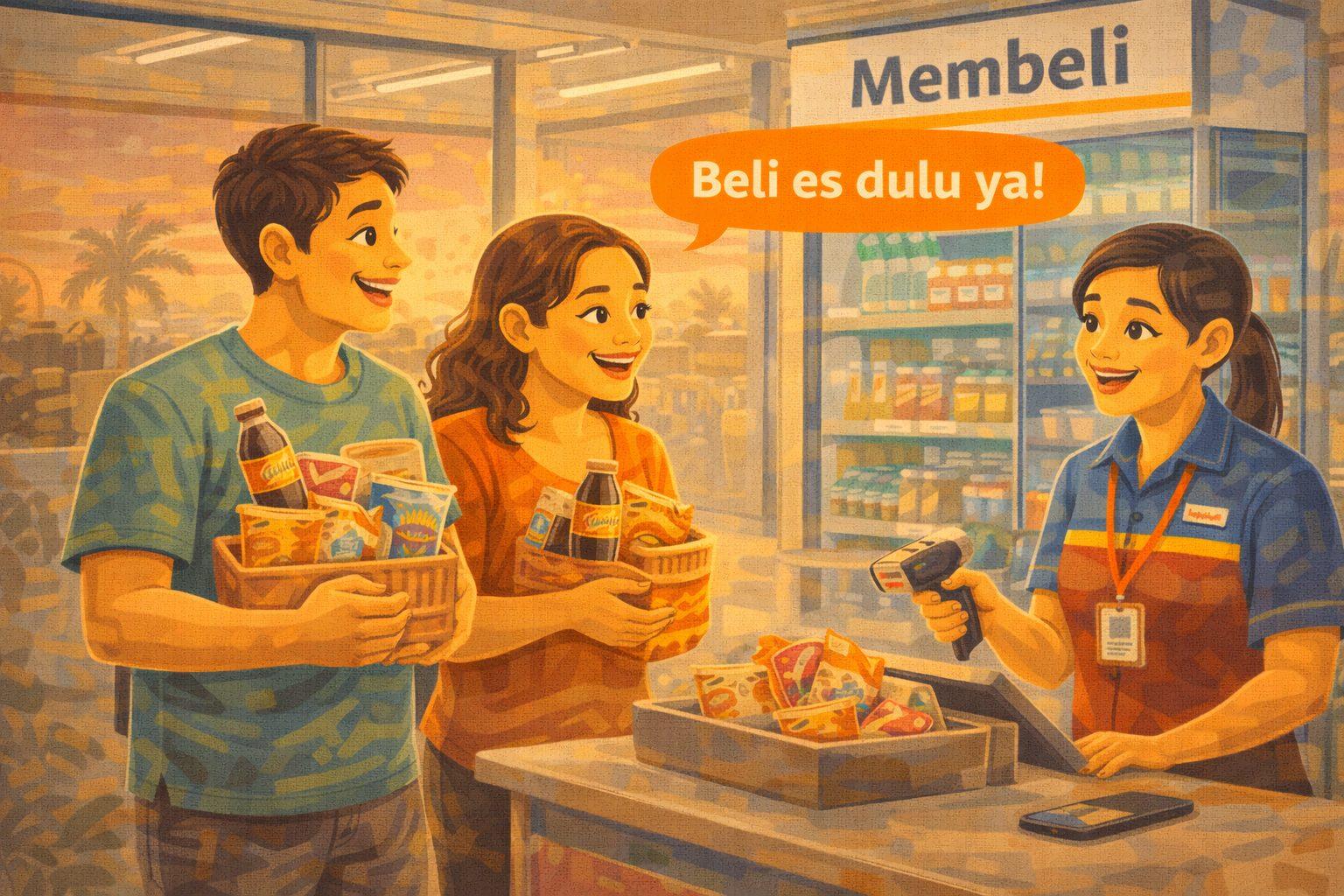
How to Say 'Membeli' in Casual Indonesian (Beli)
If you learned Indonesian from a textbook, you probably learned membeli as "to buy." That's technically correct. But nobody talks like that.
In real conversation, people just say beli.
Drop the Prefix
This is one of the most common patterns in casual Indonesian. The formal me- prefix (here mem-) just.. disappears. So membeli becomes beli. That's it. No conjugation, no extra rules. Just chop it off.
You'll hear beli constantly. Like, multiple times a day.
Examples You'll Actually Hear
"Beli di mana?" = Where did you buy it?
This one is everywhere. Someone notices your new shoes, your phone case, your lunch.. beli di mana? It's almost reflexive.
"Beli apa?" = What are you buying?
Simple and direct. You'll hear this at markets, malls, or when someone walks in carrying a bag.
"Gue mau beli [X]" = I want to buy [X].
Gue is casual Jakarta-style "I." Swap in whatever you're shopping for. Gue mau beli kopi. Done.
Level Up: Beliin Dong
Now here's where it gets fun. "Beliin dong" means "Buy it for me." The -in suffix turns beli into "buy (for someone)," and dong adds a friendly, slightly pleading tone. You'll hear friends say this all the time. 😄
Bonus: The Same Pattern Works for "Sell"
Formal menjual becomes just jual.
"Jual berapa?" = Selling for how much?
Super useful at markets and street stalls.
Shopping Vocab to Pair With Beli
- Murah = cheap
- Mahal = expensive
- Diskon = discount
- Gratis = free (everyone's favorite word)
You can mix and match. "Ada diskon nggak?" = Is there a discount? "Kok mahal banget?" = Why is it so expensive?
Try It
Next time you're at a warung or chatting with an Indonesian friend, skip membeli entirely. Just say beli. It'll sound way more natural.
So.. what do you want to beli first? 🛒
Keep learning
Related articles

How to Say 'Namun' and 'Akan Tetapi' in Casual Indonesian (Tapi)
Stop sounding like a newspaper. Learn why 'tapi' replaces 'namun' and 'akan tetapi' in everyday Indonesian, plus other formal conjunctions you can simplify.

How to Say 'Uang' in Casual Indonesian (Duit)
Uang is the textbook word for money in Indonesian.. but duit is what people actually say. Plus the slang terms for common rupiah amounts.

How to Say 'Meskipun' in Casual Indonesian (Walaupun, Walau)
Meskipun is the textbook 'although' but it's too formal for everyday speech. Learn how Indonesians actually say 'even though' with walaupun, walau, and sometimes just tapi.