How to Say Memasak in Casual Indonesian (Hint: Nobody Says Memasak)
Nobody says "memasak."
Seriously. I lived in Jogja for months before I realized my Indonesian textbook had been lying to me. I'd walk into a warung, try to make small talk with the ibu running the place, and drop "memasak" into conversation like some kind of.. cooking robot.
She smiled politely. But I could tell. Something was off.
The Real Word: Masak
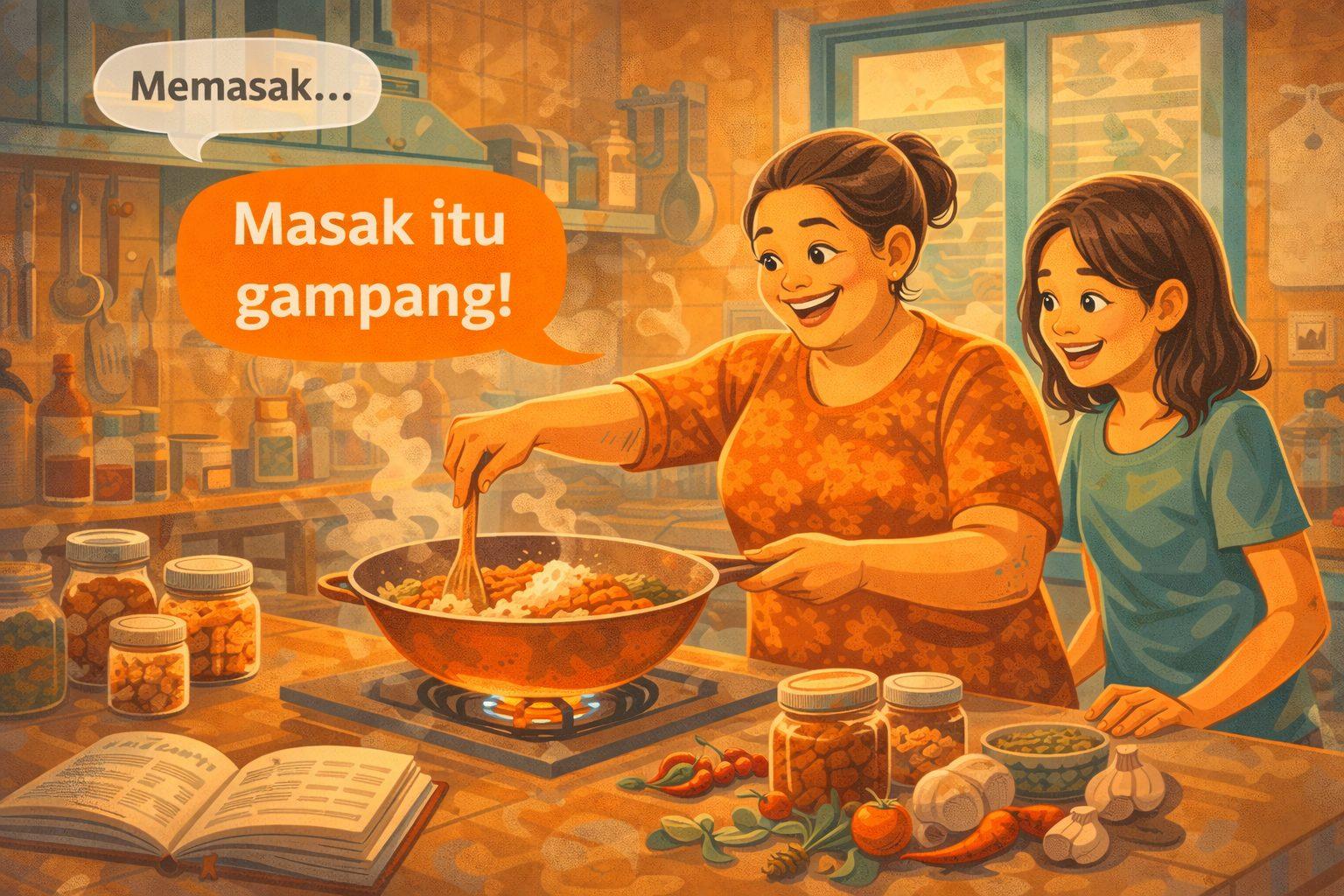
Here's the deal. "Memasak" is the formal, dictionary-perfect version of "to cook." It's grammatically correct. It's also what a news anchor would say while reading a teleprompter about a cooking competition.
Real people say masak.
That's it. Just masak.
"Lagi masak apa?" (What are you cooking?) — this is what you'll actually hear in kitchens across Indonesia. Not "sedang memasak apa." Nobody talks like that at home.
Indonesian has this pattern. The me- prefix makes verbs formal. Menulis becomes nulis. Membeli becomes beli. Memasak becomes masak. Drop the prefix and you sound like a human being instead of a government pamphlet.
Phrases You'll Actually Hear
Let me give you the ones I picked up just by hanging around kitchens and warungs.
"Masak apa?" — What are you cooking? This is everyday. You'll hear it between neighbors, between family members, in WhatsApp messages. Short. Direct.
"Yang masak siapa?" — Who's cooking? / Who cooked this? You say this when food appears and you want to know who to thank. Or blame. 😄
"Udah masak belum?" — Is it cooked yet? / Have you cooked yet? Context matters here. Could be asking about the rice. Could be asking if dinner is ready.
"Gak bisa masak" — Can't cook. You'll hear younger Indonesians say this about themselves, usually followed by laughter and a confession that they survive on GoFood orders.
"Masak sendiri" — Cook it yourself / I cooked it myself. Depending on tone, this is either pride or a challenge.
Beyond Masak: Cooking Verbs That Matter
Masak is the gateway word. But Indonesian cooking vocabulary goes deep. Here are the verbs you need if you want to talk about food like a local.
Goreng — to fry. This one you probably know from nasi goreng (fried rice) and mie goreng (fried noodles). But it shows up everywhere. "Goreng telur" is just frying an egg. Simple.
Rebus — to boil. "Telur rebus" is a boiled egg. "Mie rebus" is boiled noodles, the soupier cousin of mie goreng. You'll see both on every warung menu in the country.
Tumis — to stir-fry / sauté. "Tumis kangkung" (stir-fried water spinach) is one of those dishes that costs almost nothing but tastes incredible when done right. Every warung has their version.
Kukus — to steam. "Nasi kukus" is steamed rice. You'll hear this less in casual conversation but it's on menus everywhere.
Bakar — to grill. "Ikan bakar" (grilled fish) and "ayam bakar" (grilled chicken) are staples. If you're near the coast, ikan bakar is basically a religion.
Aduk — to stir. "Aduk terus" means keep stirring. I heard this one a lot when someone was trying to teach me how to make sambal without burning it. I burned it anyway.
The Kitchen Vocabulary Nobody Teaches You
Textbooks give you "memasak" and call it a day. But a real kitchen conversation needs more.
Kompor — stove. Most Indonesian kitchens run on gas stoves. "Nyalain kompor" means turn on the stove. You'll hear "kompornya mati" when the gas runs out. And it always runs out at the worst time.
Wajan — wok. The center of Indonesian cooking. Everything gets cooked in the wajan.
Bumbu — spices / seasoning. "Bumbu dasar" is the base spice paste. When someone says "bumbunya kurang," it means the seasoning needs more. More what? Just.. more.
Sambal — chili sauce/paste. Not ketchup. Not Sriracha. Sambal is its own universe. Every region has a different one. Every family has their own recipe. Mess with someone's sambal recipe at your own risk.
Mateng — cooked / done. The casual version of "matang." "Udah mateng belum?" is how you ask if the food is done. Again, drop the formal version. Matang is for textbooks. Mateng is for real life.
Gosong — burned. "Nasinya gosong!" means the rice burned. This is the sound of panic in an Indonesian kitchen. 🔥
Warung Culture: Where Cooking Meets Community
You can't talk about cooking in Indonesia without talking about warungs.
A warung is.. everything. It's a restaurant. It's a living room. It's a community center. It's someone's front yard with plastic chairs and the best food you've ever had for 15,000 rupiah.
The ibu who runs the warung wakes up at 4 AM. She preps the bumbu. She cooks massive batches of rice, lauk (side dishes), and sayur (vegetable dishes). By 11 AM, everything is laid out and people start showing up.
You point at what you want. She piles it on a plate. You eat. You pay. Maybe you chat for a while. That's it.
I asked one warung owner once, "Ibu masak dari jam berapa?" (What time do you start cooking from, Bu?) She laughed and said "Subuh." Dawn. Every single day.
That's the thing about masak in Indonesia. It's not a hobby. It's not a trend. It's the backbone of daily life. Cooking is how people show love, build community, and make a living. The ibu at the warung isn't a "chef." She's just masak. Every day. Without fail.
The Me- Problem
Here's why this matters for your Indonesian.
If you use "memasak" in casual conversation, people will understand you. You won't be misunderstood. But you'll sound distant. Formal. Like you learned Indonesian from a government textbook. Which.. you probably did. We all did.
The me- prefix is grammatically correct. But spoken Indonesian drops it constantly. This isn't slang. This isn't "incorrect." It's just how the language works in real life.
Memasak becomes masak. Memotong becomes motong. Mencuci becomes nyuci. Menggoreng becomes nggoreng or just goreng.
Once you start hearing this pattern, you can't unhear it. And your Indonesian instantly sounds more natural.
Quick Practice
Try these out next time you're talking to an Indonesian friend or ordering food.
Instead of: "Saya sedang memasak nasi goreng." Say: "Lagi masak nasi goreng." (I'm making fried rice.)
Instead of: "Siapa yang memasak makanan ini?" Say: "Yang masak ini siapa?" (Who cooked this?)
Instead of: "Apakah kamu bisa memasak?" Say: "Bisa masak gak?" (Can you cook?) 😏
Instead of: "Saya tidak pandai memasak." Say: "Gak jago masak." (I'm not good at cooking.)
See the difference? Shorter. Punchier. More human.
Wrapping Up
Masak is one of those words that unlocks a whole layer of Indonesian life. Food is central to everything here. Social gatherings. Family time. Business meetings. Random Tuesday afternoons.
Learn masak. Learn goreng, rebus, tumis, bakar. Hang out at a warung. Ask the ibu what she's cooking. Say "masak apa hari ini, Bu?" and watch her light up.
Drop the me- prefix. Sound like a person, not a textbook.
So here's my question for you. What's the first Indonesian dish you'd try to masak at home? And be honest. Are you brave enough to make your own sambal from scratch?
Keep learning
Related articles

Stop Saying 'Baik' — How Real Indonesians Actually Say 'Okay'
Baik sounds stiff and formal. Learn the casual Indonesian alternatives — oke, sip, siap, yaudah, gas — and when to use each one.

How to Say 'Oleh Karena Itu' in Casual Indonesian (Hint: Nobody Says That)
Stop sounding like a textbook. Learn the casual Indonesian connectors real people use — makanya, jadinya, terus, abis itu, soalnya, biar — and ditch oleh karena itu forever.

How to Say 'Mengirim' in Casual Indonesian (Kirim, Ngirim)
Mengirim is the textbook word for 'to send' in Indonesian.. but nobody actually says it. Here's how kirim and ngirim work in real life.