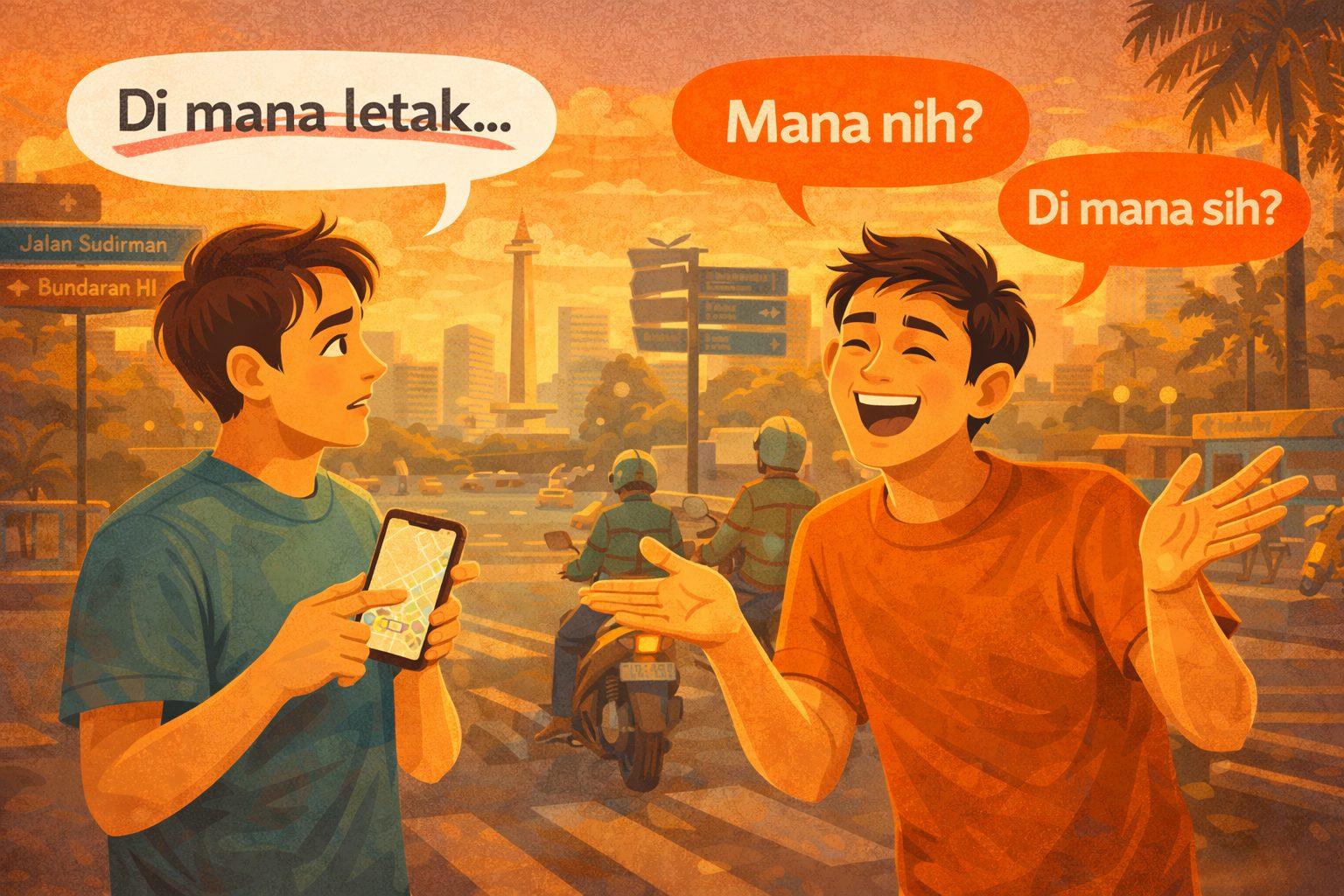
How to Say 'Di Mana' in Casual Indonesian (Hint: Nobody Actually Says 'Di Mana')
Your textbook taught you "di mana." Your textbook lied.
Okay not lied. But it gave you the formal version. The version you'd use in a speech. Or a job interview. Or if you were a newsreader on TV in 1998.
On the street? On WhatsApp? At a warung at 2am? Nobody says "di mana."
They say dimana. Or just mana. Or they skip the question entirely and send you a Google Maps pin.
Let me break it down.
The Formal → Casual Pipeline
Indonesian has this beautiful pattern where formal phrases get compressed over time. "Di mana" is a textbook example. Literally.
Here's the evolution:
Di manakah → di mana → dimana → mana
That -kah suffix? It's a formal question marker. Think of it like "wherefore" in English. Technically correct. Nobody uses it. Your Indonesian friend would stare at you if you said "di manakah toilet?" They'd point you to the bathroom.. but they'd also wonder if you time-traveled from a 1970s textbook.
In real life, it's just:
"Toiletnya mana?" (Where's the bathroom?)
Done. Simple. Four syllables instead of seven.
"Lo Dimana?" — The Most Common WhatsApp Message in Indonesia
I'm convinced that "lo dimana?" is the most-sent message in Indonesian WhatsApp history. If you've ever tried to meet up with someone in Jakarta, you know.
Lo dimana? (Where are you?)
That's it. That's the message. You'll get it fifteen minutes after the agreed meeting time. Then again ten minutes later. Then a voice note saying the same thing but louder.
Sometimes it gets even shorter:
Dimana lo? — same thing, flipped word order. Slightly more impatient.
Mana lo? — now they're annoyed. You were supposed to be there twenty minutes ago.
Mana? — just.. mana. One word. They're done being polite.
I lived in Bandung for a while and I swear my most-used Indonesian phrase wasn't "terima kasih" or "selamat pagi." It was "gue di jalan" (I'm on the way) — which was usually a lie — sent in response to "lo dimana?"
The WhatsApp Pin Revolution
Here's something funny. The question "lo dimana?" is slowly dying. Not because people stopped wanting to know where you are. But because of location sharing.
These days, the conversation goes:
🟢 A: Lo dimana?
🔵 B: (sends live location pin)
No words. No typing. Just a pin. 📍
Some people don't even ask anymore. They just send their own pin first. The whole exchange happens without anyone typing "dimana" at all.
Language evolving in real time. Wild.
"Ke Mana" and "Dari Mana" — The Direction Twins
"Mana" doesn't just mean "where." It plugs into direction words too.
Ke mana? (Where to? / Where are you going?)
This one is huge. "Mau ke mana?" is basically a greeting in Indonesia. Your neighbor says it. The security guard says it. The ojek driver says it. Half the time they don't actually care where you're going. It's just.. how you say hi.
Casual version: Mau ke mana? → Mo kemana? → Kemana?
Then there's the reverse:
Dari mana? (Where from? / Where have you been?)
Same deal. Your neighbor sees you walking home. "Dari mana?" They don't need a detailed itinerary. Just say "dari sana" (from over there) and everyone's happy.
Casual: Dari mana? → Darimana? → just Dari mana lo? with that flat Jakarta tone that makes everything sound like a statement.
"Mana" as "Which One" and "Show Me"
This is where it gets interesting. "Mana" isn't just "where." Context changes everything.
Mana? can mean:
- Where? — "Rumahnya mana?" (Where's the house?)
- Which one? — "Yang mana?" (Which one?) — you'll hear this constantly when shopping
- Show me / prove it — "Mana buktinya?" (Where's the proof?)
That third one is spicy. When someone makes a big claim and you hit them with "mana?" it's basically saying "oh yeah? Prove it." Short. Confrontational. Effective.
You'll also hear:
Yang mana aja (whichever one / any of them) — when you genuinely don't care which option someone picks.
"Dimana-Mana" — Everywhere
Double it up and you get dimana-mana (everywhere).
"Macet dimana-mana." (Traffic jams everywhere.)
If you've been to Jakarta, that sentence needs no further explanation. 🛵
You can also say ke mana-mana (to everywhere / all over the place):
"Dia suka jalan ke mana-mana." (She likes to travel all over the place.)
"Mana Bisa" — No Way
This one catches learners off guard. "Mana bisa" literally translates to "where can" but it actually means "no way" or "how could that be possible."
🟢 A: Gue bisa ngomong lima bahasa. (I can speak five languages.)
🔵 B: Mana bisa! (No way!)
It's disbelief. Skepticism. Sometimes playful, sometimes dead serious.
Similar energy: Mana mungkin (how is that possible / impossible)
"Mana mungkin dia lulus, dia gak pernah belajar." (No way he passed, he never studies.)
These are incredibly common. You'll hear "mana bisa" multiple times a day if you're hanging out with Indonesians.
The Cheat Sheet
Let me give you the quick reference:
| Textbook | Real Life | Meaning |
|---|---|---|
| Di mana? | Dimana? / Mana? | Where? |
| Ke mana? | Kemana? | Where to? |
| Dari mana? | Darimana? | Where from? |
| Di manakah? | (don't) | (just don't) |
| Yang mana? | Yang mana? | Which one? |
| Di mana-mana | Dimana-mana | Everywhere |
| — | Mana bisa | No way / impossible |
Quick Tips
Drop the space. "Di mana" becomes "dimana" in casual writing. Technically Indonesian grammar says it should stay as two words. Nobody cares in a WhatsApp chat.
Drop the "di" entirely when context is obvious. "Mana?" is enough.
"Mau ke mana" is a greeting, not an interrogation. Don't overthink your answer.
When someone sends you "lo dimana?" just share your live location. Welcome to 2026. 😄
One More Thing
The beauty of "mana" is how much work one tiny word does. Where. Which. Prove it. No way. Everywhere. All from the same two syllables.
Indonesian is efficient like that. The casual register strips away everything unnecessary. No suffixes. No formal markers. Just the core meaning.
That's what makes street Indonesian so different from textbook Indonesian. The textbook gives you the scaffolding. The street tears it down to the studs.
So here's my question for you: what's the "mana" moment that tripped you up? The first time someone hit you with a "mana bisa" and you had no idea what just happened? Or maybe you're still stuck saying "di manakah" to confused becak drivers?
Let me know. I've been there. 🙃
Keep learning
Related articles

How to Say Pekerjaan in Casual Indonesian (Hint: Nobody Says Pekerjaan)
Learn how Indonesians actually talk about work in everyday conversation. Forget 'pekerjaan' — it's 'kerjaan.' Plus the casual work vocab you need to survive small talk in Jakarta.

How to Say 'Mendengar' in Casual Indonesian (Denger)
Learn how Indonesians actually say 'to hear' in everyday conversation. Spoiler: it's not mendengar.
How to Say 'Membaca' in Casual Indonesian (Baca)
Membaca is the formal way to say 'to read' in Indonesian. In everyday speech, everyone just says baca. Here's how it works.