
How to Say Berenang in Casual Indonesian (Hint: Drop the Ber-)
Your textbook taught you berenang.
Indonesians say renang.
That's it. That's the lesson. You can close this tab now.
..OK fine. There's more to it. Let me explain.
The Ber- Prefix Is Optional (and Mostly Ignored)
If you've studied Indonesian formally, you learned that ber- is a prefix that turns nouns into verbs. Renang (swim) becomes berenang (to swim). Jalan (road) becomes berjalan (to walk). Clean. Logical. Textbook perfect.
Nobody talks like that.
In casual Indonesian, the ber- prefix drops constantly. Just like the me- prefix. Your teacher probably didn't mention this. Mine didn't either.
I figured it out sitting at a warung in Canggu, overhearing two guys planning their afternoon.
"Renang yuk." (Let's swim.)
Not "ayo berenang." Not "mari kita berenang." Just.. renang yuk.
Two words. Done.
Renang Yuk: The Phrase You'll Hear Everywhere
"Renang yuk" is how Indonesians casually suggest going for a swim. You'll hear it at villa pools in Seminyak. At beach clubs in Uluwatu. At the neighborhood kolam renang where kids splash around after school.
Let's break it down:
- Renang — swim
- Yuk — let's (casual invitation particle)
- Kolam renang — swimming pool (kolam = pool/pond)
Some more examples you'll actually hear:
"Gue mau renang dulu." (I wanna swim first.)
"Lo bisa renang?" (Can you swim?)
"Kemarin renang di pantai." (Yesterday I swam at the beach.)
See? No ber- in sight. The formal berenang isn't wrong. It's just.. textbook. Like saying "I would like to go for a swim" instead of "wanna swim?"
Nyebur: When Swimming Isn't Graceful Enough
Here's a word your textbook definitely skipped.
Nyebur.
It means to jump in. Plunge in. Cannonball into the water without thinking about it. It's beautifully casual and perfectly Indonesian.
"Nyebur aja!" (Just jump in!)
"Nyebur ke laut yuk." (Let's jump in the ocean.)
"Udah panas banget, nyebur deh." (It's so hot, I'm jumping in.)
I first heard nyebur at a waterfall near Munduk in north Bali. A group of local kids were standing at the edge, daring each other. Then one of them just.. went. "NYEBUR!" they all yelled, laughing.
It's onomatopoeia too. Say it out loud. Nyebur. You can almost hear the splash. 💦
Main Air: How Kids (and Everyone Else) Say It
Ask a kid in Indonesia what they did at the beach and they won't say "berenang."
They'll say main air.
Literally: play water. More naturally: play in the water.
"Anak-anak lagi main air." (The kids are playing in the water.)
"Yuk main air di pantai." (Let's go play in the water at the beach.)
It covers everything. Splashing. Wading. Floating on a pool noodle. Half-swimming with your head above water because you're holding your phone. All of that is main air.
Adults use it too. Especially when the activity is more "hang out in the water" than "swim laps." Which.. let's be honest.. is most of the time in Indonesia.
Indonesia Is Water. Learn the Water Words.
Indonesia is 17,000 islands. You're surrounded by ocean. The water vocabulary matters here more than almost anywhere else on earth.
Here's your essential casual water vocab:
Beach life:
- Pantai — beach
- Ombak — waves
- Pasir — sand
- Laut — sea/ocean
- Nyebur ke laut — jump in the ocean
Water activities:
- Renang — swim (casual)
- Berenang — swim (formal, textbook)
- Snorkeling — snorkeling (borrowed directly from English, pronounced roughly the same)
- Selam — dive (from menyelam, again dropping the me- prefix)
- Nyebur — jump in / plunge in
- Main air — play in the water
- Surfing — surfing (another English loan word, very common in Bali)
Places:
- Kolam renang — swimming pool
- Kolam — pool/pond
- Air terjun — waterfall (literally: falling water)
Beach Culture in Bali, Lombok, and Beyond
If you're living in Bali, this vocab is daily life.
Kuta has the big ombak for surfers. Sanur is calm. Good for main air with kids. Nusa Penida has the crystal water where everyone goes snorkeling. Lombok's Gili islands are where you go to selam and see turtles.
I spent a month on Gili Air once. Every morning the same routine. Coffee. Walk to the beach. Nyebur. That was it. That was the whole plan.
The locals there would ask "Mau renang?" (Wanna swim?) or "Mau selam?" (Wanna dive?) Never the formal versions. Never berenang. Never menyelam.
In Lombok, I heard kids at the beach yelling "Ayo nyebur!" while running full speed into the waves. No hesitation. No testing the water temperature with one toe. Just.. nyebur. There's something very Indonesian about that energy. 🌊
The Pattern: Ber- and Me- Drop in Casual Speech
This isn't just a renang thing. It's a pattern.
Once you see it, you'll notice it everywhere:
| Formal | Casual | Meaning |
|---|---|---|
| berenang | renang | swim |
| berjalan | jalan | walk |
| bermain | main | play |
| bekerja | kerja | work |
| berbicara | bicara / ngomong | speak/talk |
| menyelam | selam / nyelam | dive |
| memotong | motong | cut |
| menulis | nulis | write |
The ber- drops. The me- drops (and sometimes the first consonant of the root word changes). This is casual Indonesian 101. But most courses don't teach it until way too late.
Learn the casual forms first. You can always add the prefix back when you need to sound formal. Going the other direction is harder. Trust me.
Quick Recap
- Berenang → renang in casual speech
- Renang yuk = let's swim
- Nyebur = jump in / plunge in (very casual, very fun to say)
- Main air = play in the water (what everyone actually does at the beach)
- Selam = dive (casual form of menyelam)
- Kolam renang = swimming pool
- The ber- prefix drops in casual Indonesian, just like me-
Now Go Nyebur
You don't need to memorize conjugation tables. You need to get in the water.
Next time you're at a pool in Bali or a beach in Lombok, try it. Turn to whoever you're with and say:
"Renang yuk?"
Or better yet, skip the invitation. Just nyebur. 🏊
So what's your favorite spot to renang in Indonesia? Drop it in the comments.
Keep learning
Related articles

How to Say 'Mohon' in Casual Indonesian (Hint: You Don't)
Mohon is way too formal for everyday Indonesian. Learn the casual alternatives — tolong, dong, and the -in + dong pattern that makes any verb a friendly request.

How to Say 'Oleh Karena Itu' in Casual Indonesian (Hint: Nobody Says That)
Stop sounding like a textbook. Learn the casual Indonesian connectors real people use — makanya, jadinya, terus, abis itu, soalnya, biar — and ditch oleh karena itu forever.
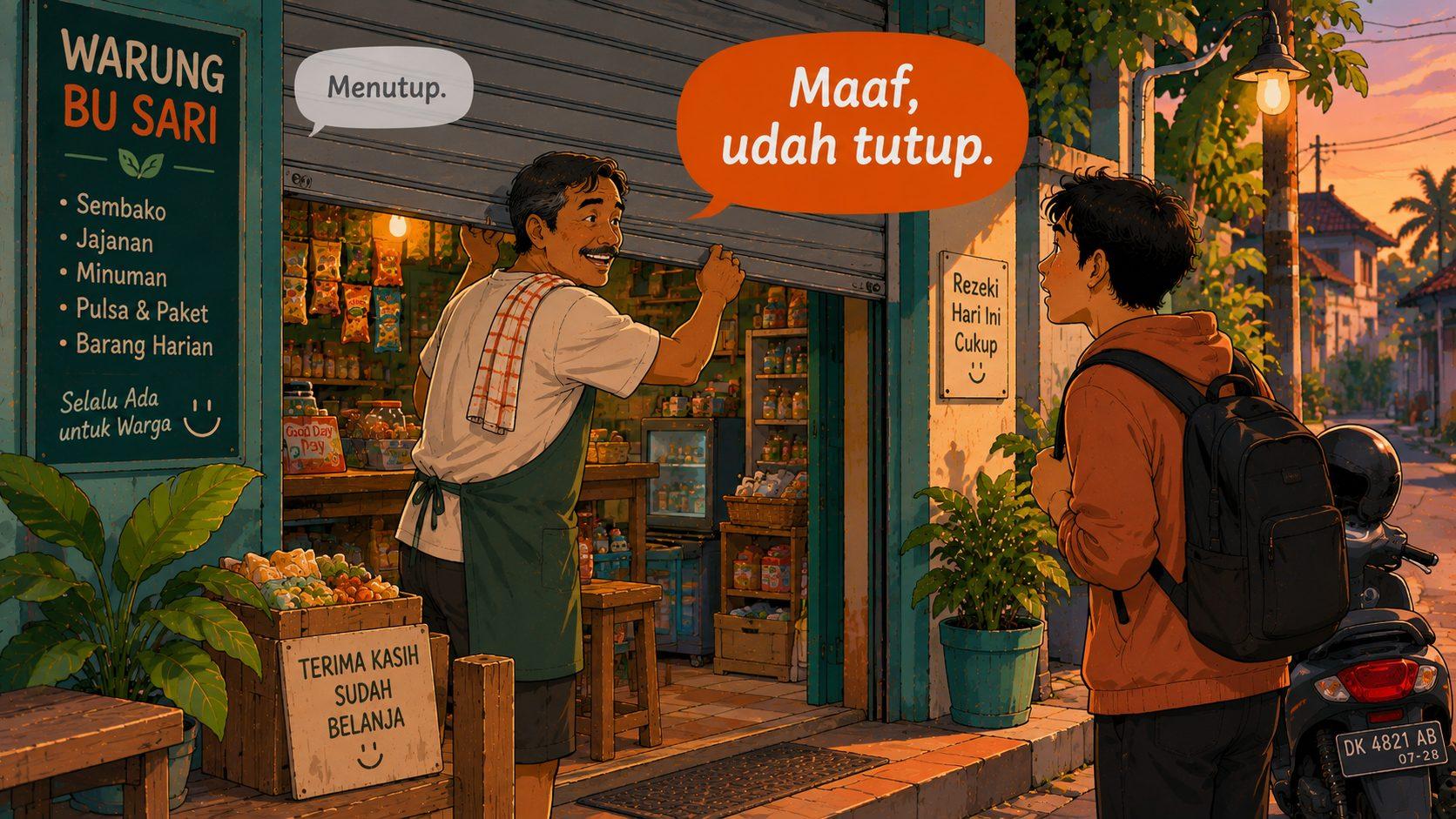
How to Say Menutup in Casual Indonesian: Nutup, Tutup & When Things Are 'Udah Tutup'
Nobody says 'menutup' on the street. Learn the casual Indonesian words for closing — tutup, nutup — plus everyday expressions like tutup mulut, tutup mata, and the flexible meaning of 'udah tutup.'