
How to Say 'Akan' in Casual Indonesian (Mau vs Bakal)
If you learned Indonesian from a textbook, you probably learned akan. The formal future tense marker. "Will" or "going to."
Saya akan pergi ke Jakarta.
Clean. Correct. And.. kind of stiff.
Here's the thing. Indonesians almost never say akan in casual conversation. It sounds like you're reading a news broadcast. Or giving a speech. Nobody talks like that at the warung.
So what do people actually say?
Mau: The Swiss Army Knife 🔪
Mau is probably the single most useful casual Indonesian word you can learn. It does double duty. It means "want to" AND "going to."
- Gue mau pergi. (I'm going to go / I want to go.)
- Mau ke mana? (Where are you going?)
- Lo mau makan apa? (What do you want to eat?)
- Gak mau. (Don't want to. / Won't.)
That second one.. Mau ke mana? You'll hear it constantly. It's basically the Indonesian version of "What's up?" People say it as a greeting. Your neighbor says it. The ojol driver says it. Everyone says it.
Context tells you whether mau means "want" or "will." Usually it doesn't even matter. The meanings blur together. You want to do something, so you're going to do it. Simple.
Bakal: When You're More Sure
Bakal is the other casual replacement for akan. It leans more toward certainty. Less about desire, more about prediction.
- Besok bakal hujan. (It will rain tomorrow.)
- Dia bakal datang kok. (He'll come, don't worry.)
- Gue bakal telat. (I'm going to be late.)
See the difference? You wouldn't say mau hujan because the rain doesn't "want" anything. (Well.. some people do say it, but that's another post.) Bakal works when you're stating what will happen. It's a prediction, not a desire.
Quick Comparison
| Formal | Casual (want/intent) | Casual (prediction) |
|---|---|---|
| Saya akan pergi | Gue mau pergi | Gue bakal pergi |
| Saya akan makan | Gue mau makan | Gue bakal makan |
The Shortcut
When in doubt, just use mau. Seriously. It covers like 80% of future-tense situations in daily conversation. Bakal fills in the rest.
Drop akan from your casual vocabulary. Save it for writing formal emails and impressing your Indonesian teacher 😄
So.. what other textbook words have you been using that nobody actually says in conversation?
Keep learning
Related articles

The -kan to -in Suffix Swap in Casual Indonesian (Bikinin, Ambilin, Beliin)
In casual Indonesian, the formal -kan suffix becomes -in. Learn how bikinin, ambilin, beliin, and cariin work with real examples you'll actually hear.
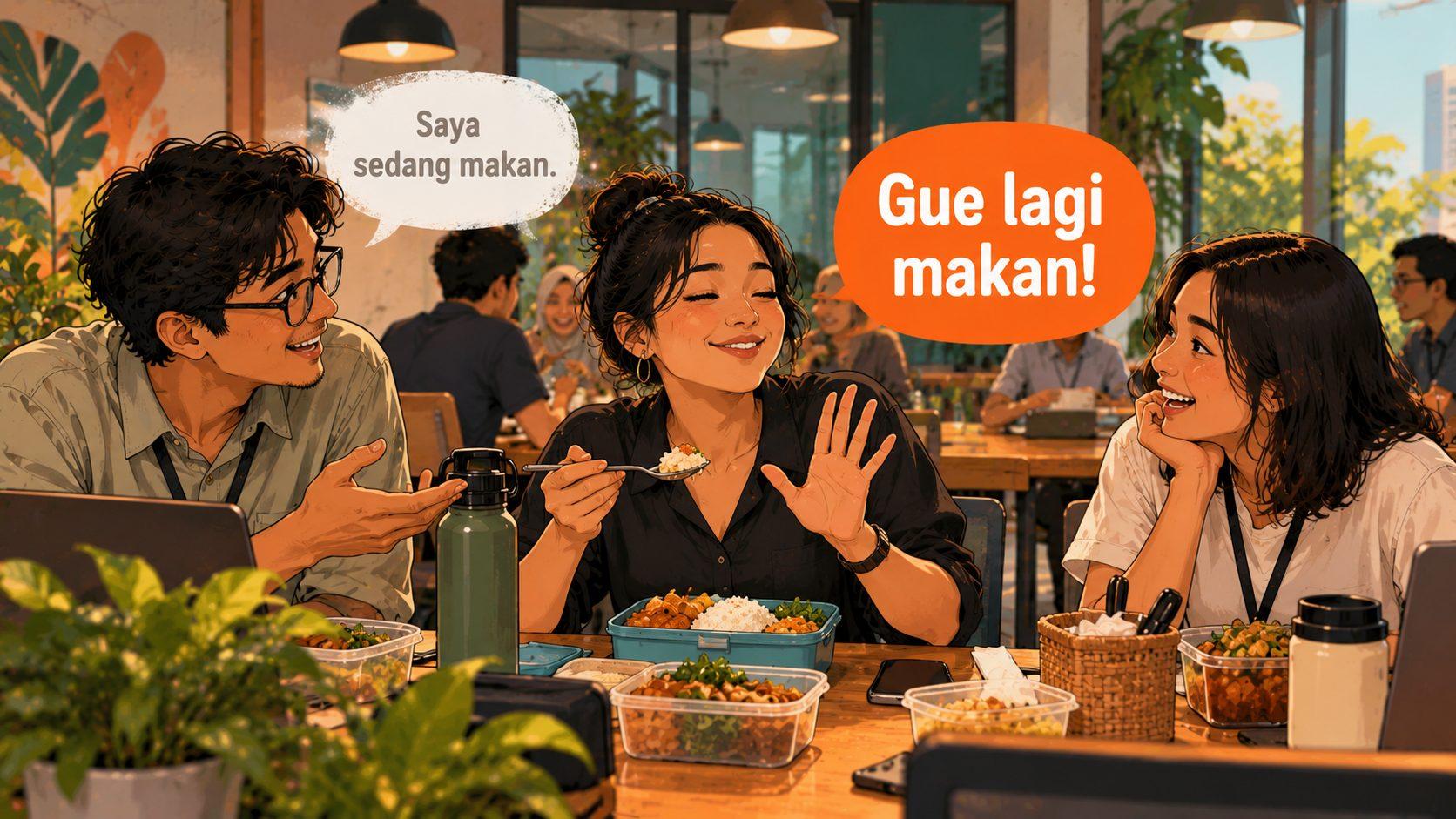
How to Say 'Sedang' in Casual Indonesian (Just Say 'Lagi')
Stop saying 'sedang' in conversation. Learn how Indonesians actually express present continuous tense with 'lagi', one of the most versatile words in casual Indonesian.

How to Say Pekerjaan in Casual Indonesian (Hint: Nobody Says Pekerjaan)
Learn how Indonesians actually talk about work in everyday conversation. Forget 'pekerjaan' — it's 'kerjaan.' Plus the casual work vocab you need to survive small talk in Jakarta.